


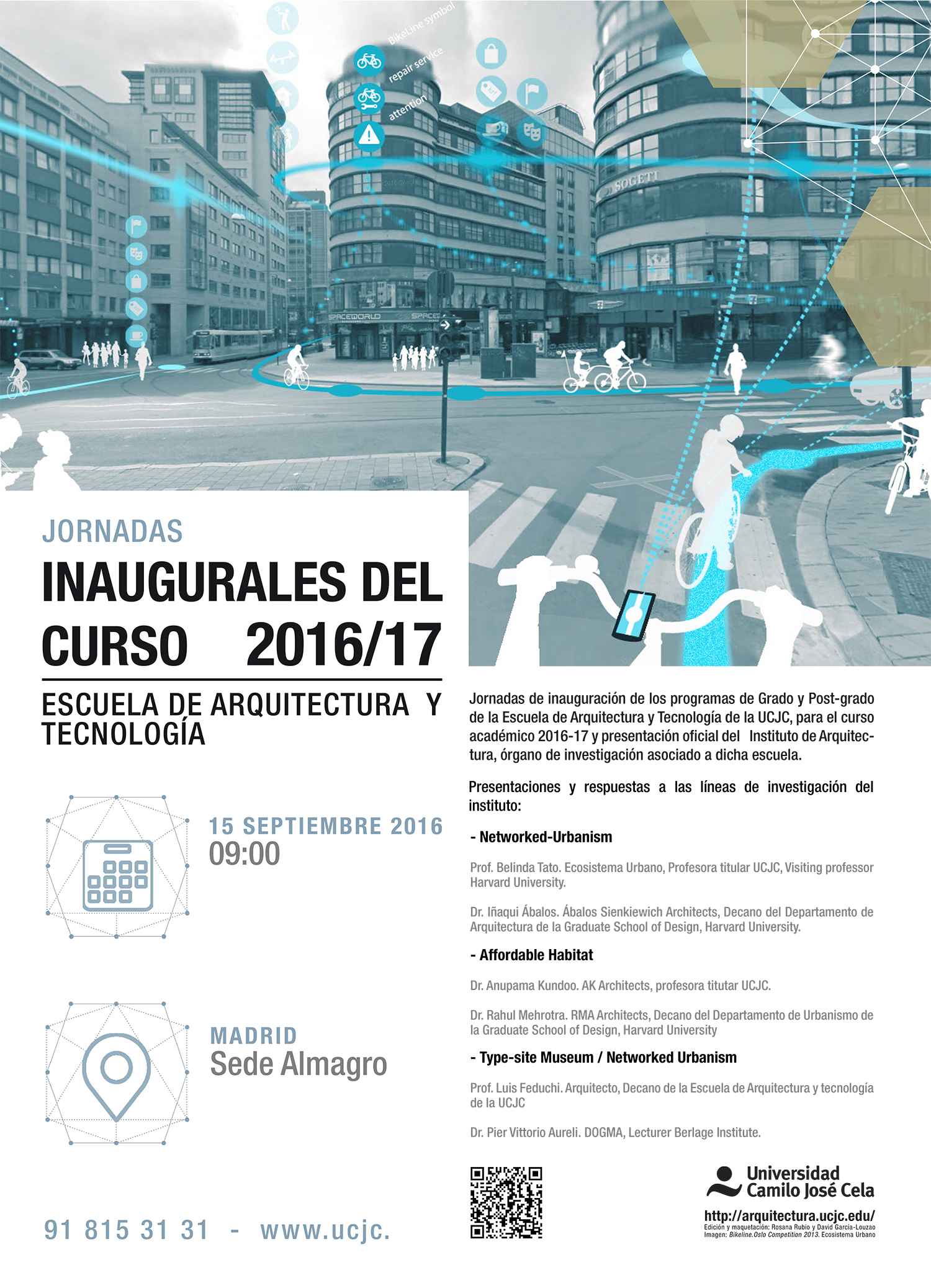

Hoy publicamos una entrevista, la primera de una serie de tres, que han realizado stepienybarno para su blog, sobre el Máster en Arquitectura y Energía de la Universidad Camilo José Cela (UCJC), en el cual Belinda Tato dirige el curso de especialización Networked Urbanism.
networkedurbanism
May 31, 2016
March 8, 2016

Next friday, Belinda Tato will participate in the Doctor design Conference 2016 lecture, #decoding practice, at the Graduate School of Design, Harvard.
Other speakers include Benjamin H. Bratton, John van Nostrand, Vyjayanthi V. Rao and Antón García Abril, among others.
An extract from the conference brief:
The conference investigates the impact of codes, concerned with mapping of environments, demarcation of legal territories, operational protocols of logistics and risk management, and codes of building and subtraction. By exposing the spatial and socio-cultural implications of micro-politics embedded in the hidden codes and protocols, we speculate about the potential agency of design practices mediating between processes of normalization, and the live, complex, and unpredictable ecologies of human habitation.
Belinda Tato will present ecosistema urbano’s latest projects in Latino America, Russia and Europe.
More info here
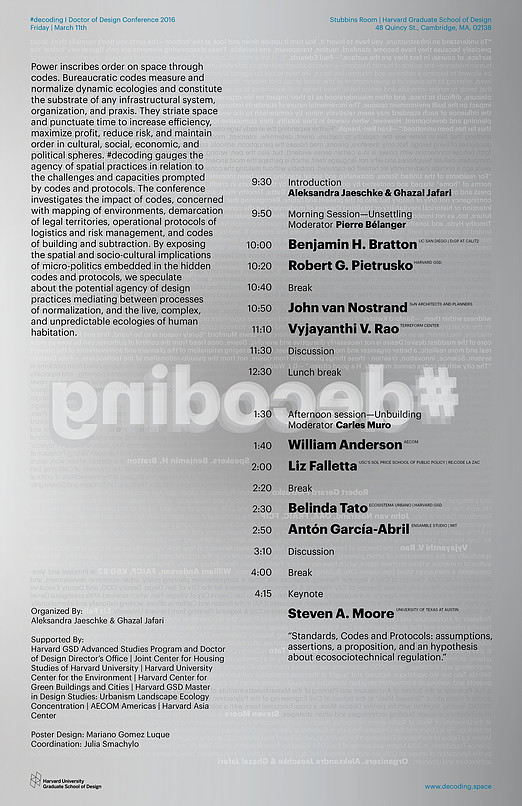
#decoding
2016 Doctor of Design Conference
March 11th, 2016
9.30am – 5pm
Stubbins Room
Harvard Graduate School of Design
48 Quincy St., Cambridge, MA, 02138
Conference website: decoding.space
January 19, 2016
Como os contamos anteriormente en este post, el pasado Diciembre realizamos la instalación Networked Urbanism en la UABB | Bi-city Biennale of Architecture/Urbanism en Shenzhen, en la sección Radical Urbanism, siendo invitados por Alfredo Brillembourg y Hubert Klumpner.
Antes de llegar a la definición de la forma final de la instalación así como se presenta hoy —visitable en la antigua fábrica de harina Dacheng hasta el 4 de Marzo 2016— en ecosistema urbano tuvimos una efervescente fase de reuniones creativas y experimentaciones con diferentes formas de comunicación y representación de los proyectos.
Desde el principio teníamos la idea de transformar el espacio a disposición para la instalación (7,30 x 2,50 m) en un ambiente muy visual, que atrajese a los visitantes desde distancias lejanas — diseño gráfico y colores brillantes — y también, una vez dentro del propio espacio, por algunos elementos más pequeños, emblemáticos y misteriosos, visibles a medias: dispositivos para generar curiosidad.
El común denominador de todos los elementos que componen la instalación corresponde con 3+1 requisitos:
1. Ser low bulk, de poco peso y tamaño, para poder ser transportada por dos personas de España a China como equipaje facturable en cualquier compañía aérea.
2. Ser low maintenance, utilizando tecnologías simples y que no necesiten mantenimiento durante los cuatro meses de la Biennale.
3. Ser low cost, teniendo en cuenta el bajo presupuesto disponible.
4. Y además, claro, ser novedoso, divertido, sorprendente…
Este cuádruple reto nos enganchó igual que otras veces en las que hemos intentado aplicarlo, como la instalación Jardín de Sueños en Bahamas o la exposición Formula X en el DAZ de Berlín.
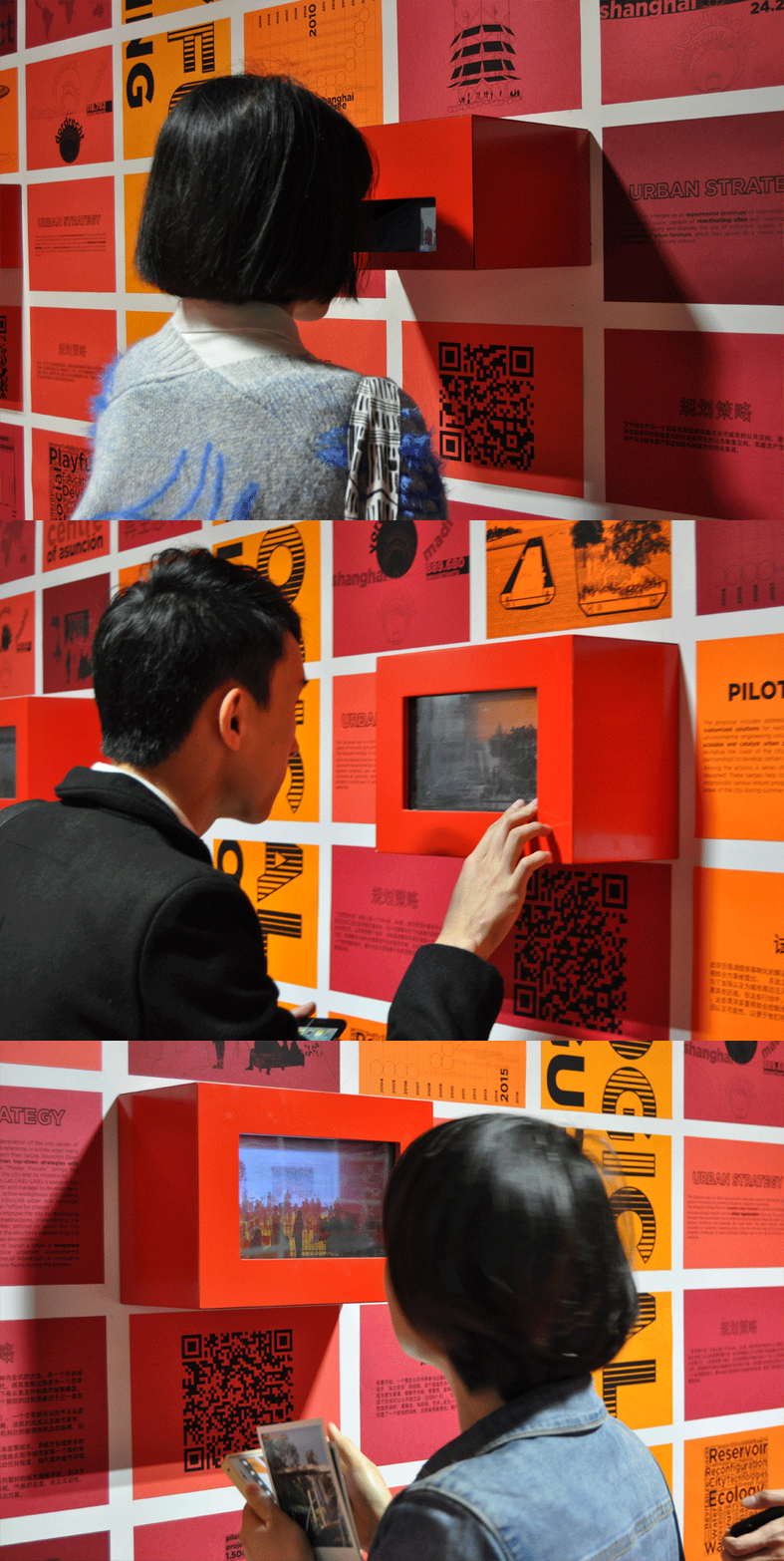
Comenzamos a desarrollar la idea de contener artefactos en una caja que motivase los visitantes a acercarse y explorar los micromundos contenidos en ella. Cada caja debía contener los elementos necesarios para describir de manera abstracta y al mismo tiempo comprensible, cada uno de los 11 proyectos que narran la filosofía del Networked Urbanism, tema de la instalación. Hicimos entonces un trabajo de exploración de referencias de diferentes técnicas, entre ellas: el vídeo, los libros pop-up, la superposición de capas transparentes impresas, las ilusiones ópticas del efecto Moiré, figuras efímeras como resultado de sombras de diferentes objetos, etc.º Os compartimos nuestro tablero de Pinterest con una buena colección de referencias sobre el tema.

Referencias encontradas en la fase de investigación. Fuente: https://it.pinterest.com/ecourb/shenzhen-installation/
Particularmente inspiradora fue una visita al Museo del Cinema de Turín dentro de la imponente Mole Antonelliana; en este hay una amplia sección totalmente dedicada a las técnicas que permitían de crear animaciones en los siglos antes el nacimiento del cine. En el fascinante mundo precinematográfico se crearon una gran cantidad de dispositivos y objetos misteriosos, capaces de maravillar también al espectador contemporáneo. Entre estos extraños objetos se encuentran cajas ópticas, linternas mágicas, phenaquistiscopios, taumatropi y muchos más. Para los que quieren explorar más el tema del precinematografía, aquí dejamos un link de Wikipedia bastante exhaustivo.

Vista interior de una caja óptica del siglo XVIII, con transición de luz de día/noche

Diorama del siglo XVIII – Museo del Cinema, Torino y diorama contemporaneo creado por Harikrishnan Panicker y Deepti Nair
Decidimos entonces crear dos tipos de cajas: un diorama y una caja que contuviese algo más que un vídeo, un holograma.
La realización de la primera tipología de caja, el diorama, consistió en la descomposición de una representación en perspectiva del proyecto en 5 o 6 dibujos impresos en acetato transparente y dispuestos en secuencia, de manera que la correcta visión de la imagen fuese posible exclusivamente desde un único punto de vista. En el fondo de la caja, una pantalla proyecta ambientaciones, colores y fondos que animan el diorama y establecen un diálogo con los elementos impresos de las distintas capas.

Diorama del proyecto Dreamhamar
El segundo tipo de caja, el que contiene el holograma, requirió una fase de experimentación y pruebas más larga. En primer lugar hay que decir que probablemente crear estos hologramas sin Internet habría sido mucho más complicado para nosotros. Pero afortunadamente vivimos en la época del conocimiento compartido, y pudimos encontrar en Youtube una serie de tutoriales que explican cómo realizar un holograma casero de manera muy sencilla, con sólo una pantalla y una pirámide de plástico transparente. A continuación os dejamos uno de los varios vídeos que podréis encontrar por la red.
Una vez aprendida la técnica (afinada y personalizada, a través de numerosos prototipos, para nuestras necesidades específicas) tuvimos que realizar los vídeos que cuentan los restantes 6 proyectos de Networked Urbanism, siguiendo el criterio de dejar el fondo negro e invertir/reflejar las imágenes para su correcta visualización.

Hologramas | work in progress

Caja con el holograma del Ecobulevar
Los otros vídeos realizados para ser visualizados como hologramas están disponibles en estos links: Ecópolis Plaza, Air Tree Shanghai, Energy Carousel, Madrid Chair. ¡Construyendo una pirámide transparente, tu también puedes visualizar estos vídeos como hologramas!
Las 11 cajas fueron diseñadas ad hoc para la instalación por ecosistema urbano y posteriormente realizadas a corte láser por EXarchitects.
Para saber más sobre el resultado final, aquí dejamos el link a otro post y el teaser de Networked Urbanism. Enjoy!
December 21, 2015

Between November and December 2015 we spent one week in Shenzhen on the occasion of the 2015 Bi-City Biennale of Urbanism/Architecture, being invited by curators Alfredo Brillembourg and Hubert Klumpner to be part of the Radical Urbanism section of the exhibition. The brief of this edition of the Biennale is “Re-Living the city”, a reflection about reuse and rethinking existing buildings, the reimagination of our cities, and the remaking of our daily lives by design. The main location of the event was connected to the topic of the Biennale: the former Dacheng Flour Factory has been transformed into a massive container of thoughts and innovative practices in urbanism without hiding its recent past of industrial activity and its uncertain future.

The Dacheng Flour Factory_ Image: UABB
Our installation at the UABB Biennale, called Networked Urbanism, displays a selection of pilot projects exploring physical and immaterial urban improvement, a critical catalogue of their urban contexts, the understanding of urban complexity and the new tools developed to address it. The colourful multimedia exhibition displays 10 pilots projects, implemented during the past 10 years in different contexts around the world, but also displays 1 mockup, a real scale version of an urban furniture design.
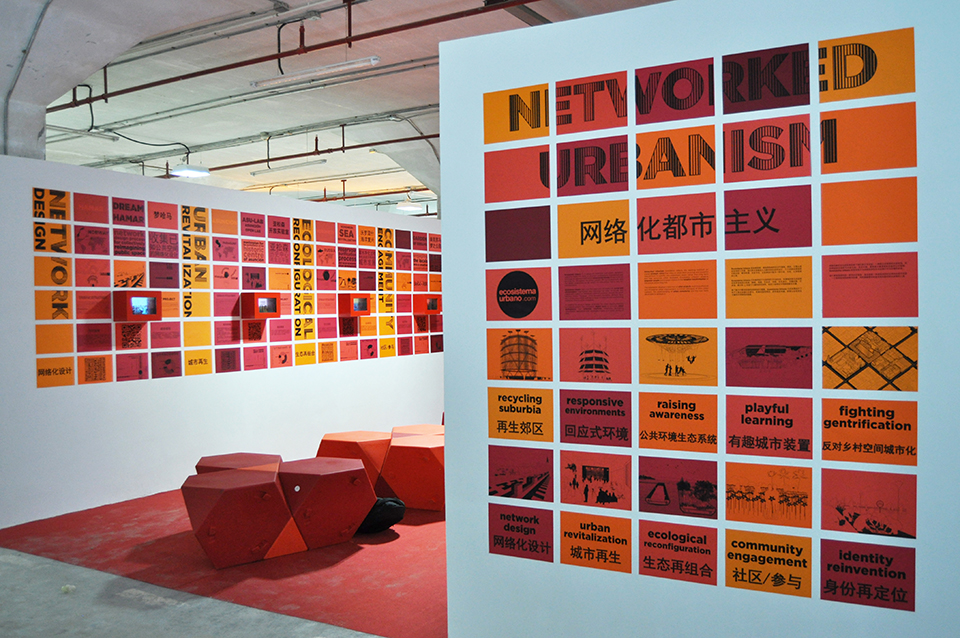
The Networked Urbanism Installation reflects the working method: an overall strategic vision that relies on short term punctual and powerful interventions in specific and emblematic spots (pilot projects), rather than long term and high resources urban strategies. Ecosistema Urbano’s projects empower people and engage citizens in the tangible transformation of the places where they live.
The definition and final layout of the installation was an intense process of research and real scale experimentation to find interactions between graphic design, communication, animation and optical effects. We tried to show the common philosophy behind each project in a very visual and communicative way. Each pilot project is communicated with a graphic slogan synthesizing the nature of the intervention and its message, a reference to the city where the project is implemented, and a description of the overall urban strategy.


10 pilot projects
Moreover, a digital layer of information is added to the graphic display. 5 multimedia dioramas provide an intriguing representation of the following pilot projects: Exuma Garden of Dreams, Dreamhamar, Asunción Open Lab, Voronezh Sea Revitalization, and Encarnación Sustainable Development Territorial Plan.
Diorama for the project Dreamhamar
The other 5 pilot projects presented in Networked Urbanism installation are described throughout short movies displayed as holograms, thanks to a DIY fascinating technique. The videos of the projects Ecobulevard, Air Tree Shanghai, Ecópolis Plaza, Energy Carousel, Escuela Febres intervention in Cuenca , explain with 3d holograms the complexity of this interventions, showing the different layers and their several possible points of view and configurations.
Hologram of Ecobulevar project
1 Mockup
Well centered on the main wall of the space lays the message “Customize public space“, surrounded by drawings of the possible configurations of Madrid Chair. In the central area of the exhibition there are 18 pieces of this flexible and multipurpose urban furniture in red and orange versions allowing visitors to interact and create their own favourite exhibition layout.
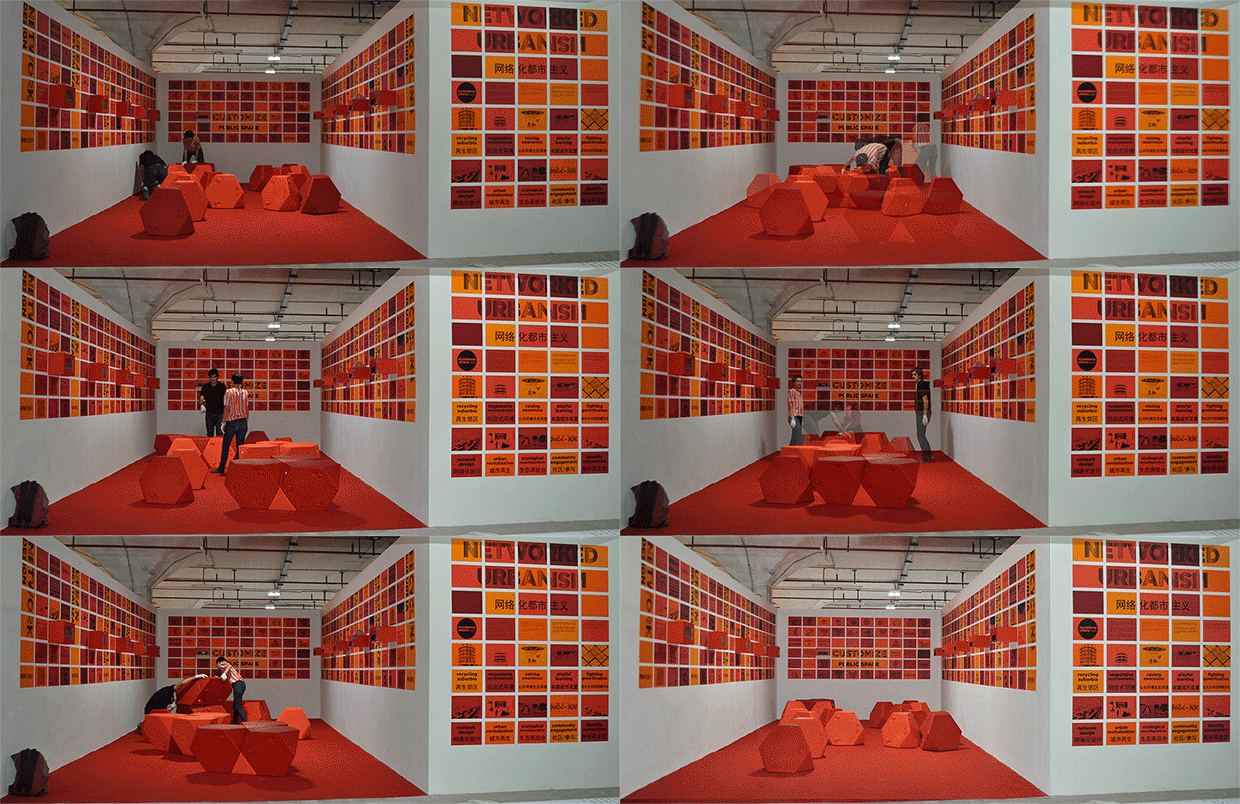
Assembly phase of Madrid Chairs

The UABB Biennale will be open until March 3rd 2016, if you are planning to visit Shenzhen, don’t miss it!
June 29, 2015

This is the second part (see the first part here) of our conversation with Paul Bottino, cofounder and executive director of TECH, Technology and Entrepreneurship Center at Harvard. Here you can read the first part.
BT&JLV The learning experience includes the possibility to learn from consequences, mistakes, and successes. This methodology emphasizes the value of the process itself, in contrast to a teaching approach primarily focused on the end results. How would you value the process versus the end results? Can we introduce failure/uncertainty as part of the development of the learning process?
PB You are being charitable because we people have proven ourselves pointless predictors! And our ever-growing connectedness and complexity are going to give computer power and big data analytics a long battle before we get much better. So as far as I can see, the value is in the process, and the end results are more or less kaleidoscopic: when the twirling stops for an instant, we see a pattern, rationalize how we got there, codify explanations, and issue predictions based on the code. The twirl resumes and reminds us of our folly but we can’t give up the game and our illusion of control. My response is to emphasize good practice—valuing process over results—in the hope that more often than not good results will emerge from good practice. Part of any good practice is periodic reflection intended to prolong the period where one is open to discovering the right practice for the right situation. That reflection includes looking at how the failure and uncertainty inherent in the process affects our practice; asking how we respond to and perceive failures; and how we perform and make decisions and communicate in uncertain circumstances.
BT&JLV Think Big / Start Small are two of the ten guidelines for the course, and are also key concepts for innovation in general. Do you have any advice about how to fill the gap between the “think” phase and the “start” phase? What are the most common challenges in the transition between the design phase and the actual implementation of the project in the real world?
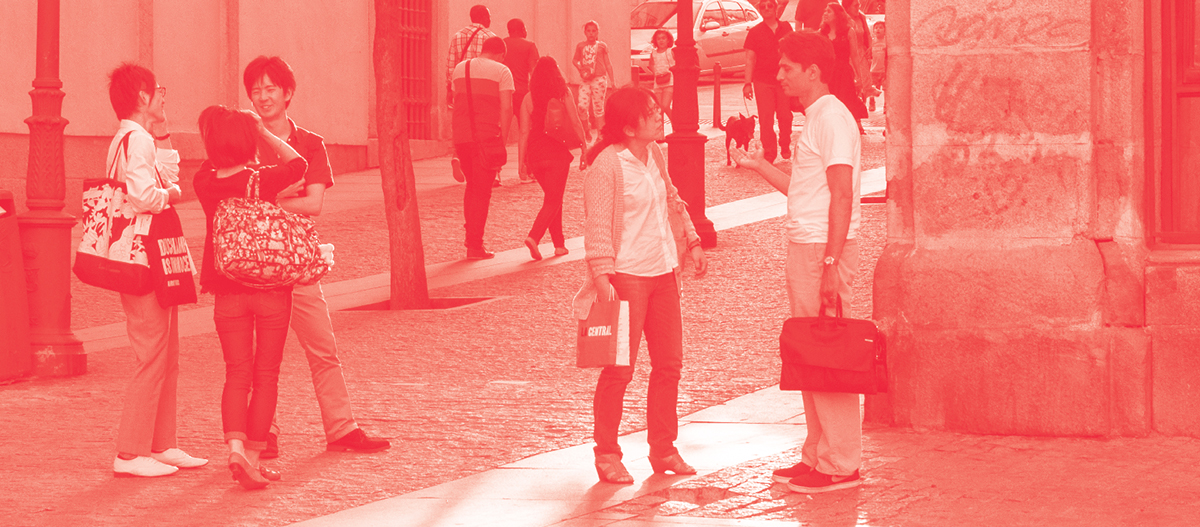
PB Your eighth guideline for the studio is a great start, “Act Now!” (and ask questions later and along the way). Whenever possible, it’s a good idea to transform thoughts and words into actions and to test them with people. It is the formulation of something that people can see, touch, and experience that stimulates the most useful feedback. It is much easier to close this gap with virtual designs than it is with physical, but you can shrink it with models and simulations. In the virtual cases, the transition isn’t a bright line but a continual back and forth—two steps forward, one step back—of testing with people and redesigning until you realize your test subjects have become users and you feel you’ve made a phase change to implementation. With physical designs and more complicated virtual designs, there are clearer phase distinctions and cut-over moments. The real learning begins when things go live. The greatest challenge I see designers face in these moments is handling the pressure and responding to the unforeseen requirements that are now coming from stakeholders external to the design team, whereas before they were self-imposed. These events stress the entire design organism, from the belief that what you are doing is valuable to the little details that make it work. The best teams use systems thinking and parallel processing to tend to the entire organism in order to be as ready as they can be for these moments.
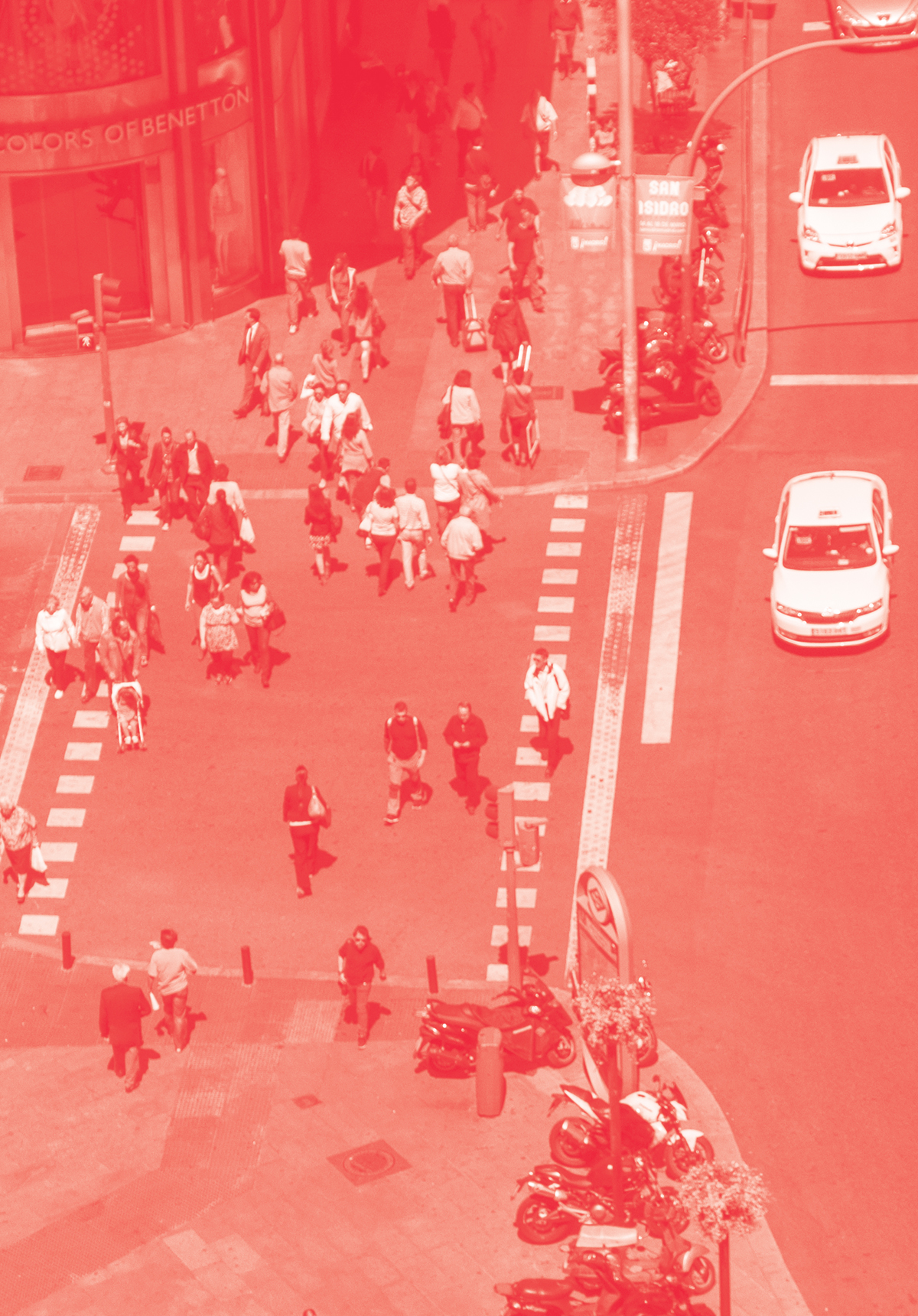
BT&JLV Historically, design schools have been somewhat segregated from other disciplines, and have been considered to be niche institutions. In the last decade, design has emerged as an overarching discipline, and design methods (design thinking) are strongly influencing other fields. These methods are frequently adopted by a wide range of disciplines, from scientific to humanistic ones.
How would you explain this opening? Has the role of the designer shifted from designing a building or product to “enhancing society”?
PB Design thinking fits a classic technology innovation paradigm, which is it takes on the order of 30–years to emerge from inception to widespread adoption. Ideas spread faster now but the 30 year rule still works for big changes. Design thinking is “process know-how” that fits the broad definition of technology. I would trace its origins back to 1961 and the publication of Synectics by William J. J. Gordon2. So many factors contribute to where it is today but perhaps the two main ones are increasing complexity frustrating a purely analytical approach and the shift from an industrial economy to a knowledge economy where the emphasis moved from labor, equipment, and capital to people, engendering a natural embrace of the human-centered precept of design thinking. The designer’s role changed right along with that. With a focus on people, the essential question is not what to make or how to make it, it is why to make it; so inexorably, designers (which includes makers by many other formal names) engage the issue of why, embody it in their designs, and find themselves working at the highest level of value creation.
BT&JLV You work as an educator with students and professionals coming from various institutions, with different backgrounds, education, and expectations.
In your experience, do designers and/or students of design have special capabilities for creative problem solving?
PB All children have the basic capabilities and unfortunately it seems mainstream schooling retrains them to concentrate on solving right-answer problems with predetermined tools. Design students seem to have either never lost or have managed to reawaken the childhood ability to see things differently, dive into open-ended challenges and try to figure things out without knowing the “right” way. That and a healthy quotient of cultivated empathy and the energy to exercise it regularly is what I see setting design students apart.
BT&JLV Networked Urbanism provides students with a toolbox of 10 guidelines to use during the research process:
1.EXPLORE
2. RESEARCH
3. NETWORK
4. SHARE
5. BE OPEN
6. THINK BIG
7. START SMALL
8. ACT NOW!
9. COMMUNICATE
10. MOVE BEYOND
Which other ingredients would you add to it?
PB This is a tremendous set to which I’d add:
11. DECLARE your ignorance: embrace what you don’t know and can’t explain and cultivate it as an energy source to ward off the tendency to believe you have an answer before you do—and the tendency not to risk losing what you think you have.
12. DEFY known authorities: their dissonance is as good an indication of value as your adopter’s resonance.
13. FOCUS on the meaning of your design: value springs from metaphorical shifts.
14. NARRATE the story of your design complete with round characters, rich settings, true heroes, and real villains.
You can access the complete publication here
June 23, 2015
#networkedurbanism is a series of studios taught in the Urban Planning and Design Department at the Harvard University Graduate School of Design between 2010 and 2014.
The #networkedurbanism studio aims to bring network-design thinking to the forefront of design disciplines and strives to solve real-world problems on the ground, providing an alternative to the traditional approach of designing urban environments from a bird’s-eye view, and a single designer’s perspective. Networked Urbanism not only examines the physical dimension of the city, but also its social processes and fluxes, developing initiatives that generate spontaneous transformations and set up conditions for change.
The #networkedurbanism studio provides the framework for students to pursue their own interests, find their own means of expression, and create their own paths. They are encouraged to work with others, to create connections and to search for new problems and opportunities that underlie our society, visibly or subtly. Overall, they are expected to explore the city and design new tools to creatively improve urban life.
The following conversation with Paul Bottino is an excerpt from our publication Networked Urbanism, Design Thinking Initiatives for a Better Urban Life
Paul Bottino is cofounder and executive director of TECH, Technology and Entrepreneurship Center at Harvard.
“TECH’s mission is to advance the understanding and practice of innovation and entrepreneurship through experiential education: by initiating, advancing and informing student projects. TECH helps faculty create and deliver innovation and entrepreneurship project courses, provides students with project support and sponsors and advises student groups working to build the Harvard innovation community.TECH is based on the belief that boundaries—between disciplines, people, organizations, and ideas—need to be crossed continually to create the insights that lead to innovations because socially useful and commercially viable advancements require the right mix of scientific and engineering knowledge, entrepreneurial know-how, and worldly perspective.”

Belinda Tato and Jose Luis Vallejo (BT&JLV): TECH promotes experiential education, a pedagogical approach that informs many methodologies in which educators purposefully engage with learners in direct experience and focused reflection in order to increase their knowledge, develop their skills, clarify their values, and develop their capacity to contribute to their communities.
Networked Urbanism studio incorporates this methodology, requiring participants to leave their comfort zone in order to introduce them to realities in today’s society – outside the walls of Academia—in which designer’s skills are needed. Do you think that this non-academic, feedback-driven process should be used more often in design courses? Does it help to foster an entrepreneurial spirit among students?
Paul B. Bottino (PB): Absolutely. Though it is only non-academic in the sense of that word that means concerned solely with matters of theoretical importance. I consider it academic because it is central to learning, which is my chosen sense of the word. The kind of experiential education that my students and I practice does have practical ends as well as theoretical. But in a creative economy, where knowledge is the primary means of production, education is inextricably linked to practical ends. All of the educators and learners I know—be they at the lifelong, higher, secondary, elementary, or natural level—want to create useful knowledge for their desired ends, and those ends include everything imaginable on the spectrum of human experience. In my case, and I believe this is true of the Networked Urbanism studio, the end goal is to help build students’ innovative capacity.
In order to do that, educators and students must jointly go on an implicit knowledge exploration.
It is obvious but worth saying that knowledge about the future and the new designs that will inhabit it is not explicit, meaning you can’t enter search terms in Google and get answers, even if Google had access to every bit of knowledge available. Instead, it is a research process in which you craft a probe in the form of a design concept and take it to people to educe knowledge about it. If it is a new concept, which it must be to qualify as a potential innovation, then it is going to generate new thoughts. The designer takes those new thoughts not as answers, but rather as feedback. The endeavor of the designer is to transform concepts into value. Value is a utility function; it derives from the use of designs by some number of people. So the essential way designers create value is by engaging in a process of formulation-feedback-reformulation that transforms neurons firing into words, visuals, prototypes, and designs. In my experience, learning via this process is the only way to develop the kind of embodied knowledge that lasts and evolves. Willingly engaging in this full experience and being vulnerable to it is the essence of the entrepreneurial spirit. And, as Oliver Wendell Holmes, Jr., is quoted, “A mind that is stretched by a new experience can never go back to its old dimensions.”

BT&JLV Networked Urbanism encourages students to choose a topic at the intersection of their interests and society’s needs. They have to take the initiative and make decisions. Projects become unique and linked to their personal stories and many of them live beyond the term. This isn’t the traditional academic approach but it is a common entrepreneurial construct, and designers are increasingly expected to define both the problem and the solution. Do you think that “problem finding” skills have become a fundamental base for innovation?
PB Yes, most certainly. I would say those skills always have been essential to innovation, but it is probably more apt to call them something else because in many cases you don’t need to find the problem, it is in clear view. Consider certain diseases where the problems are well known—when a treatment or cure is discovered, invented, and developed, it is very likely immediately deemed an innovation. This is a process of innovation that occurs almost entirely by devising a new solution to an existing problem. I think it is fair to differentiate creative problem-solving, where the problem is given or known, from innovating, where it is not, yet still call creative solutions that are widely used, innovations. To this way of thinking, the full experience of innovating starts with some kind of finding—finding problems people don’t know they have or finding opportunities others don’t see. These kinds of findings emerge from change. Change causes uncertainty about the meaning of existing things and whether they are still useful and valuable. The designer interprets change, sees things differently, and creates new meaning and value. Because there is so much change, the possibilities are endless so it is essential to filter them through one’s values, interests, and capabilities to make a starting choice. This is wonderful for the educational experience because it supplies personal purpose, relevance, and intrinsic motivation to the exploration.

BT&JLV One of the crucial benefits during the Networked Urbanism studio has been the cross-pollination of students with many different backgrounds from all the programs within the GSD. Moreover, the collaboration with people outside of the studio enhanced the innovation of the projects exponentially, since students are required to build up connections with others, creating a network of advisors and professionals within the field, as well as existing and potential community members. Is interdisciplinary collaboration now a necessary ingredient for successful entrepreneurship and innovation?
PB It is probably too much to say that it is absolutely necessary in all cases because there will always be instances of people seeing things differently and innovating without too much assistance, but it feels like those are edge cases that are more and more extreme. More the norm is where the challenge is complex, and seeing and approaching things differently comes from a combination of perspectives and abilities. It is often hard for one person to see things differently. Some people are more agile than others at changing frames internally; most need collaboration and other inputs to do it. I think this is due to a combination of the way our neural pathways are formed and maintained and a lack of meta-thinking practice. That combined with increasingly specified knowledge domains and the training and concentration necessary to master those domains means collaborating with people from other areas, worldviews, and walks of life increases your chances of seeing things differently, getting the diversity of feedback you need and finding the knowledge resources you need to create value.
The second part of the conversation with Paul Bottino has been published in this post.
February 19, 2015

Last January Ecosistema Urbano was invited to Hong Kong to take part in activities at two different events. We were invited to give a lecture and run a workshop at Hong Kong Design Institute and also be part of the MaD ASIA FORUM 2015 program.
Hong Kong Design Institute is an educational institution that adopts a “Think and Do” approach through contemporary curriculum and active collaborations with industry. HKDI brings together the strengths of the Design departments and offers programmes spanning across Foundation Studies, Communication Design and Digital Media, Fashion and Image Design, and Product and Interior Design.

Our workshop aimed, not only at examining the physical dimension of the city, but also its social processes and fluxes, focusing in the quality of HK public spaces.
We believe that the reactivation of a public space cannot be addressed only by a conventional piece of art or urban design. A lively public space is a complex balance of overlapping layers which should also allow for improvisation and interaction; it is the platform for conversation and socialization and it should respond to the demands, desires and expectations of an increasingly plural society.
The transformation of a public space is not only about physically implementing a new creative urban environment, but also, and far more important, it is about building a community to support it, to care for it, to use it – before, during, and after its materialization. A designer’s role is not only to deliver high quality public spaces, but also to reflect on the many ways public space can contribute to foster or discourage social interaction. It is interesting to understand how the physical configuration of a space can condition our personal and social behaviour.
At ecosistema urbano we believe we have to work at different levels in order to achieve a healthy and sustainable public space. Our methodology focuses on three key factors:
Society. We believe it is necessary to empower communities to drive the projects that affect them, and therefore involve social layer in the design process, so social relevance can be guaranteed. It is necessary to invite citizens to take an active role in urban transformation.
Technology. We embrace technology as a means to enhance citizens’ interaction with each other and with the environment around them. As the digital-physical divide narrows and the possibilities multiply, technology becomes an increasingly significant element in urban social life.
Environment. Sustainability is not only an option anymore, but a must. Our work promotes the comprehension of the city as an open environmental classroom to raise awareness about ecological issues among citizens.
Within this framework, Jose Luis Vallejo and I led a 3-day workshop at Hong Kong Design Institute with students from the landscape program. The purpose of the workshop was to encourage students to reflect on the public space surrounding the school.
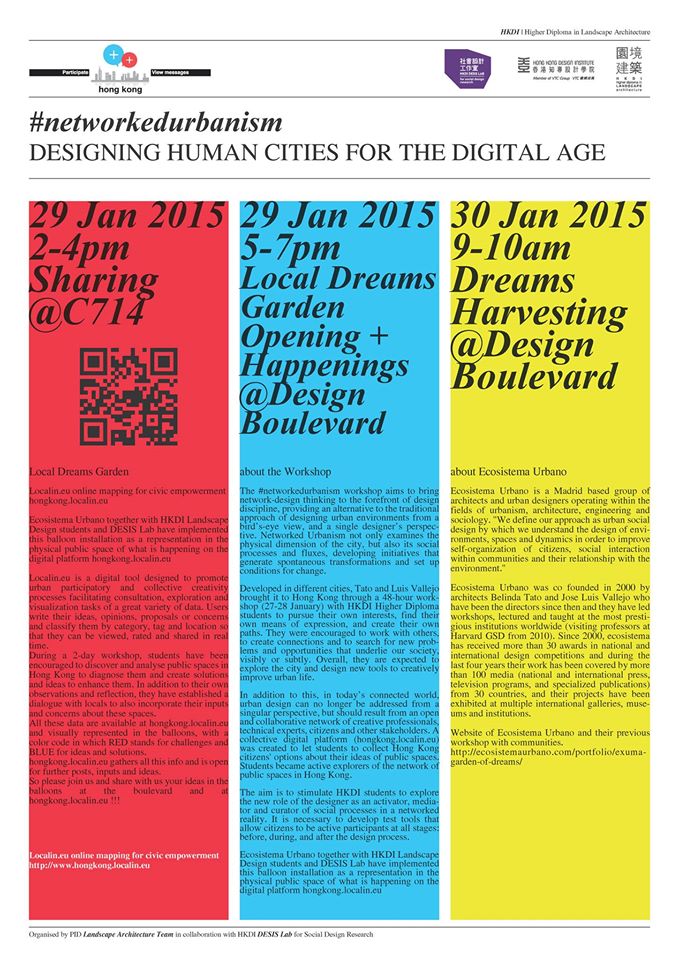
The workshop consisted of three different actions:
FIRST ACTION
During the first task students had to explore the area, identifying both challenges and opportunities in the public space of this part of the city: East Kowloon, a newly built area with a lack of attractive public spaces. They had not only to observe and experience the space themselves but also to gather inputs and fresh ideas from other users and passersby.
In order to communicate and express their learnings and findings, they were expected to elaborate their ideas by producing a video.

Today’s strong culture in the use of new media pushes us, designers, to find innovative ways of communicating our ideas beyond the conventional disciplinary tools. The easiness of spreading information through social media, reaching out a larger audience, presents new opportunities of raising awareness about urban issues, increasing social interest, and building up a stronger urban culture.
The definition and the testing of these tools is a fertile creative space where students and future designers can find new opportunities for development and innovation, where not only the very concept is important, but also the skills of storytelling and narration.
We believe Design Schools should explore these new ways of communicating and transferring ideas and knowledge to bridge the distances between disciplinary language and society’s interests. It is necessary to develop the appropriate tools and to establish a creative and efficient conversation between us, designers, and the citizens, as we no longer can think about creating a healthy and sustainable city without their engagement.
Many topics emerged from this explorative approach: the space for the visually impaired, the lack of activities and programs, the monotony of the current design and existing solutions, etc.
You can watch the videos produced here.
SECOND ACTION
The second purpose of the workshop was to launch the Hong Kong version of the local_in platform, an online platform designed to publish geolocated messages: users write their ideas, opinions, proposals or concerns in 140 characters and classify them by category, tags and location so that they can be viewed, rated and shared in real time.

The digital platform enables users to work at two different levels:
Mapping: situations, problems, opportunities through images, video, descriptions, etc.
Getting into action: posting their designs, strategies, and solutions to reactivate and dynamize the existing spaces.
There is a color code in which RED stands for problems or challenges and BLUE for ideas and solutions.
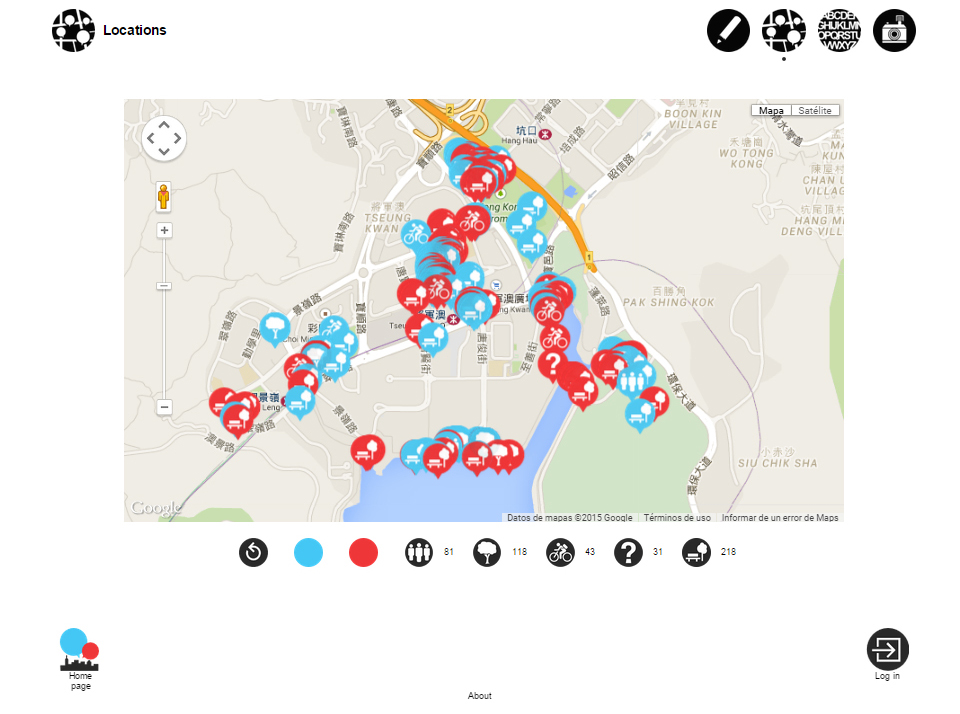
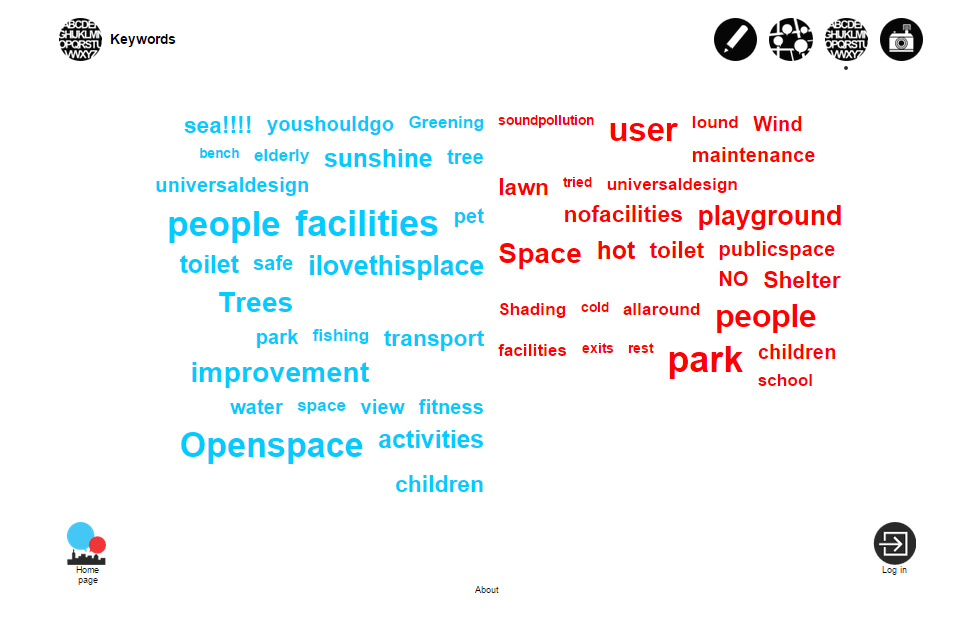

The interface is very intuitive and allows the user to visualize the information by topics and interests in any given area of the city. Students directly uploaded their findings and reflections to the online platform. The application is open source, designed and developed by Ecosistema Urbano and released under GNU GPL license.
The platform hongkong.localin.eu will remain online and open for further use by citizens.
THIRD ACTION
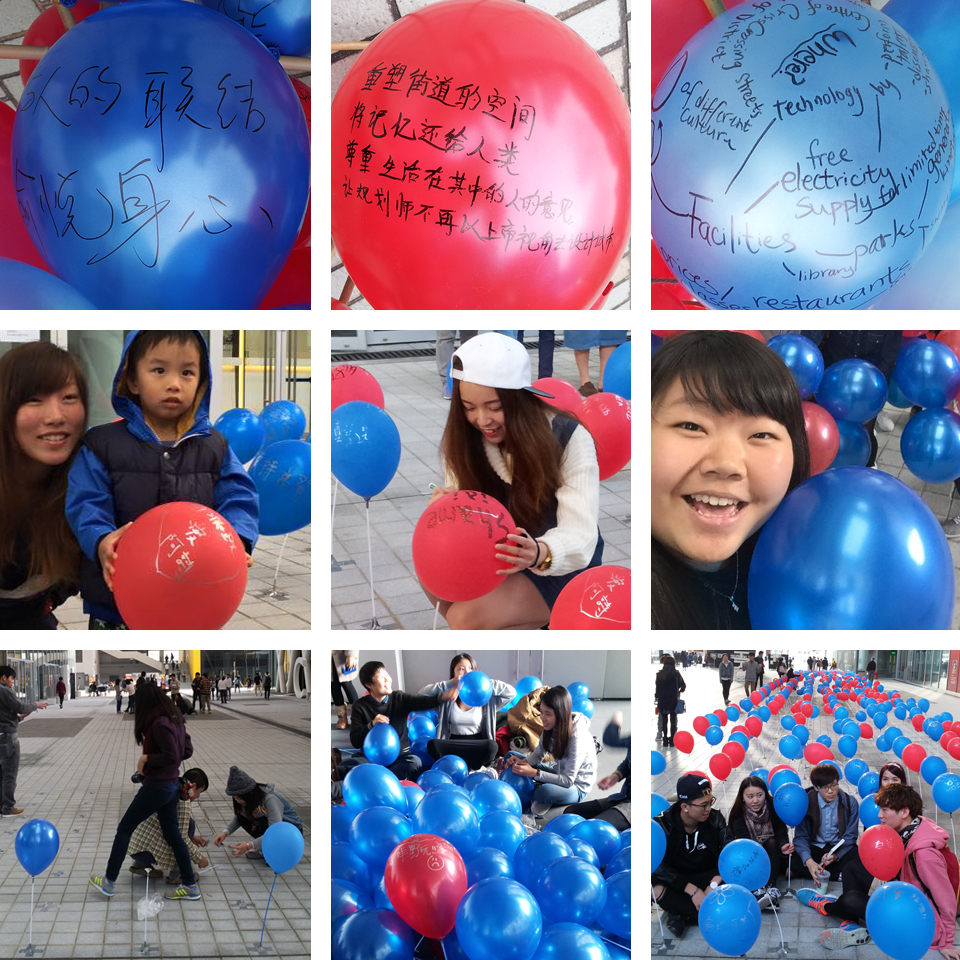
As a final and symbolic act representing the result of this reflection, a temporary balloon installation was implemented in the main public space at HKDI, the boulevar.

A series of 500 balloons were put into place, red balloons standing for problems and blue for ideas, recalling the color classification used in the local_in platform.
The installation is a symbolic representation of the digital platform and the ideas shown were a selection of the many gathered by students during the neighbourhood exploration. The ideas written in the balloons drew the attention of other students and passersby, and many of them also became engaged in the process and decided to contribute with their own thoughts. This simple mechanism became a social catalyst, sparking conversations along the space, connecting people and encouraging the reflection about the space we live in, and finally also the ideal background for many selfies, instantly shared on the social networks.

MaD ASIA FORUM 2015
In addition to this activity we also took part in the MaD ASIA FORUM 2015, a platform cultivating creativity and global vision among young people in Asia.
Founded in 2009, MaD (Make a Difference) inspires and empowers young people all over Asia to come up with creative responses to our time’s challenges. It has evolved as a collaborative platform of creative changemakers that works at the intersection of creativity, entrepreneurship, innovation and discovery to bring about positive changes in Asia.
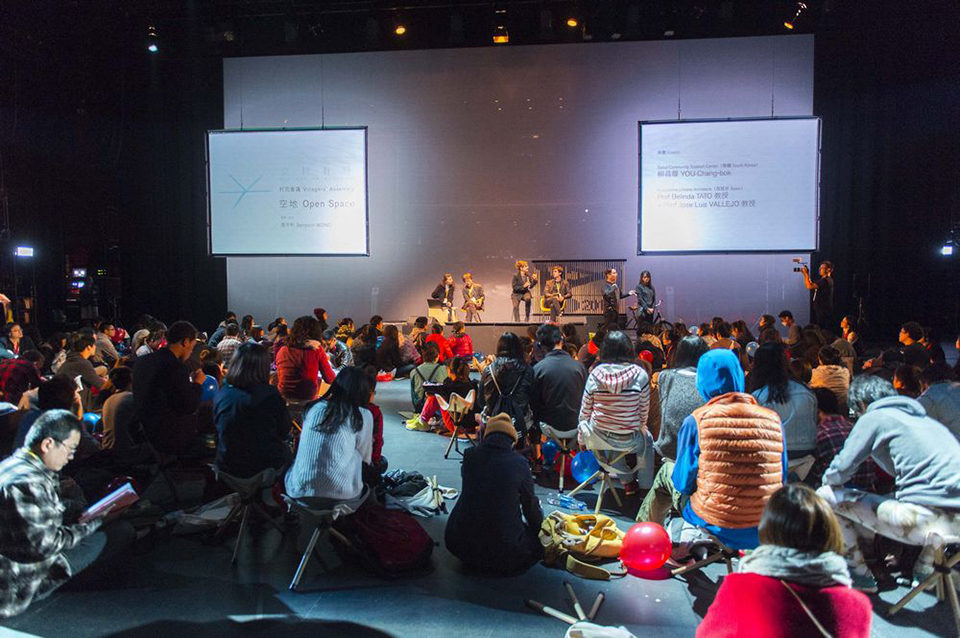

Jose Luis and I gave a lecture within the program and led two workshops titled “Designing Human Cities for the Digital Age” in which participants were challenged to interact and collectively think about ways of improving cities.
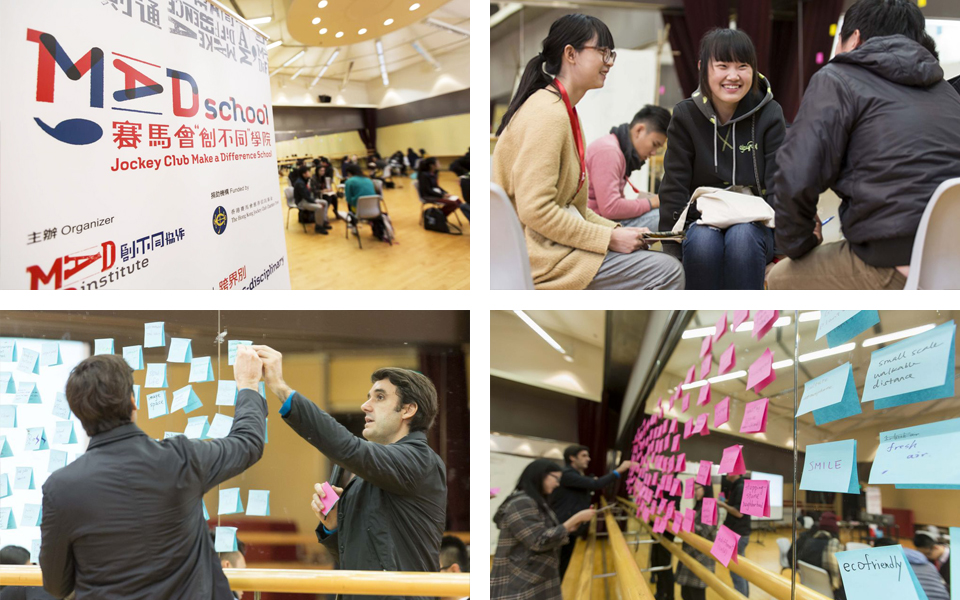

Here you can find an interview (in chinese) published in NHET magazine.
September 29, 2014

Image by Flickr user Richard Schneider
The book ‘Networked Urbanism’ included this article by Blair Kamin, the Pulitzer Prize-winning architecture critic of The Chicago Tribune, who served as a visiting critic for our “Networked Urbanism” studio.
There was no Internet in 1938 when the eminent Chicago sociologist Louis Wirth wrote his classic essay, “Urbanism as a Way of Life.” Taking note of the phenomenal growth of such industrial cities as New York and Chicago, as well as the lack of an adequate sociological definition of urban life, Wirth articulated parameters of enduring relevance.
Cities should not be defined by the quantity of their land mass or the size of their population, he wrote. Rather, they were best understood by pinpointing their distinctive qualities: “a relatively large, dense, and permanent settlement of socially heterogeneous individuals.” 1 That heterogeneity, Wirth observed, had the effect of breaking down the rigid social barriers associated with small-town and rural life. It increased both mobility and instability, causing individuals to join organized groups to secure their identity amidst the city’s ceaseless flux. “It is largely through the activities of the voluntary groups,” Wirth observed, “that the urbanite expresses and develops his personality, acquires status, and is able to carry on the round of activities that constitute his life-career.” 2

Image by Marco Rizzetto
Implicit in his analysis was the notion that these networks would be formed through the technologies of their time: By letter, by telephone, by telegraph, by the newspaper, and, of course, by face-to-face contact. Amid today’s ongoing digital revolution, that part of Wirth’s otherwise prescient analysis seems antique.
In that sense, nothing has changed and everything has changed since the publication of “Urbanism as a Way of Life” more than 75 years ago. Half of the world’s population lives in urban areas; that share, the United Nations predicts, will rise to roughly two-thirds by 2050. As in Wirth’s time, urbanization has spawned acute problems, from China’s acrid skies to India’s vast slums. Yet while urbanites still ally themselves with groups, the means by which they do this has shifted entirely. Think of the recent spate of “Facebook revolutions.” Human communication is now overwhelmingly digital, and digital urbanism has become a pervasive part of city life, whether it takes the form of sensors embedded in highways or apps that let us know when the bus is coming.
The question is whether we are fully realizing the potential of these tools to improve the quality of the built environment and, with it, the quality of urban life. In short, can the virtual enrich the physical?

Image by Carlos León
Madrid architects Belinda Tato and Jose Luis Vallejo, principals of the firm Ecosistema Urbano, believe in the value of this link and have set out to prove its worth through their practice and their Harvard University Graduate School of Design (GSD) studio, Networked Urbanism. The architects belong to a new generation that decries the self-referential “object buildings” enabled by digital design. Yet like Frank Lloyd Wright, who viewed the machine as an agent of progressive social and aesthetic change, they see the computer as a friend, not an enemy.
This perspective has helped them realize such socially-conscious projects as the Ecopolis Plaza in Madrid, which transformed an old industrial site into a child care and recreation center that is as visually striking as it is ecologically sensitive. Tato and Vallejo have imparted this creative approach to their students and the students have run with it, as the impressive results collected in this book show.
The first thing that distinguishes Tato and Vallejo’s pedagogy is its starting points, which are unapologetically practical and local–an anomaly within the theory-driven, globally-focused world of academic architectural culture. Instead of parachuting in to some far-flung locale, their students engage the place where they live: greater Boston. This affords the students time for repeat visits to their project sites and a deeper understanding of people and their needs than can be gleaned on a lightning-fast overseas tour. But it would be inaccurate to characterize the process and product of “Networked Urbanism” as parochial. The architects subscribe to the philosophy of “going glocal.” As they have written, “every urban project is born in a constant movement between the direct experience and specificity of the local context, and the global, shared flow of information and knowledge.”
One of the “glocal” issues American cities face is the rapid expansion of bicycles as a mode of transportation–a stark contrast to China, where members of the new middle-class abandon bikes for the status symbol of a car and, in the process, worsen traffic congestion and air pollution. But the growth of urban cycling has brought a dramatic increase in bicycle thefts. The vast majority of these thefts go unreported to police because the stolen bikes are rarely found. The victims feel powerless. Harvard student Lulu Zhizhou Li used to be one of them. She’s had her bike stolen twice, once from the racks in front of the GSD. “When I started talking to friends about it, I quickly realized that most everyone has had some sort of bike theft experience,” she said in an interview with Harvard’s Office of Sustainability.

BikeNapped by Lulu Zhizhou Li
Li’s response was to design a successful online platform, “Bikenapped!,” which maps where bike thefts occur. The Web site allows bike theft victims to avoid these trouble spots, share their stories and perhaps even prevent future thefts. The interactivity afforded by digital technology is crucial to the enterprise, as one posting from August 2013 shows. “Flexible Kryptonite lock was cut between 4:30-6:20 p.m. at the bike rack outside Fenway movie theatre,” a victim named Deborah wrote about the loss of her white Vita bike with small black fenders, a white seat and a value of $550. “Busy intersection, loads of people. No one saw anything. Cameras point at doors, not bike rack.” The theater’s owners are now on notice that they should reposition one of their cameras. More important, Li has drawn upon her individual experience to frame a collective digital response, one that was technologically impossible when Wirth penned “Urbanism as a Way of Life.”
The students in Networked Urbanism have taken on other pressing problems of our time, such as the need for recycling that helps protect the environment. But waste doesn’t happen by chance; it’s a result of bad design.
Consider what two students came up with as they analyzed the very Bostonian problem of discarded oyster shells. The students, Jenny Corlett and Kelly Murphy, devised a way to break the cycle of restaurants mindlessly throwing out used oyster shells, which, in turn, wind up in landfills. Their solution: Collect and dry the shells, then use them to help grow new oysters and rebuild oyster reefs in Boston Harbor.

Aquaplot by Jenny Corlett + Kelly Murphy
The plan would have a disproportionate impact because oysters affect many other species in their ecosystem. They improve water quality by removing algae, plankton and pollutants from the water. And the oyster reefs provide a habitat for small species like snails and shrimp, thereby increasing a region’s biodiversity. It’s hard to argue with projected outcomes like that– or with Corlett and Murphy’s marketing skills. Before their final presentation, they served their visiting critics oysters on the half shell.
Those who believe that architecture schools solely exist to teach students how to be heroic designers might smirk at such examples. Recently, the dean of one prestigious American architecture school provocatively argued that the problem of people complaining about object buildings is that people are complaining about object buildings. Making memorable objects, this dean said, is the core of what architects and architecture are all about.
Yet such a myopic world view privileges a formalist approach to architecture at the expense of the field’s rich social promise. Architecture isn’t a large-scale version of sculpture. It shapes the world in which we live.
The genius of Networked Urbanism is that it isn’t teaching students to be geniuses. It’s teaching them to be creative problem solvers, builders of smart digital networks and thus, builders of smarter urban communities. That’s a brighter, more responsible vision of the future than the dumbed-down version of digital urbanism you see on sidewalks today–people staring at their smart phones, lost in their own private worlds. In contrast, the projects of Networked Urbanism offer a new, intelligent way to form and vitalize the social networks that Louis Wirth identified as crucial to the continued well-being of urban life. Together, these designs confer fresh relevance upon the sociologist’s ringing declaration that “metropolitan civilization is without question the best civilization that human beings have ever devised.” 3
Blair Kamin has been the Chicago Tribune’s architecture critic since 1992. A graduate of Amherst College and the Yale University School of Architecture, he has also been a fellow at the Nieman Foundation for Journalism at Harvard University. The University of Chicago Press has published two collections of Kamin’s columns: “Why Architecture Matters: Lessons from Chicago” and “Terror and Wonder: Architecture in a Tumultuous Age.” Kamin is the recipient of 35 awards, including the Pulitzer Prize for Criticism, which he received in 1999 for a body of work highlighted by a series of articles about the problems and promise of Chicago’s greatest public space, its lakefront. Another recent story is Designed in Chicago, made in China.
1. Footnote 1 Louis Wirth, “Urbanism as a Way of Life,” American Journal of Sociology 44, no. 1 (July 1938): 8.
2. Footnote 1 Ibid., 23.
3. Footnote 1 Louis Wirth, “The City (The City as a Symbol of Civilization),” The Papers of Louis Wirth, the Joseph Regenstein Library, Special Collections, University of Chicago, box: 39, folder: 6.
September 8, 2014
 Book Cover
After several months of work here in Madrid, collaborating with our associate editors at the GSD in Boston, we are happy to announce that the Networked Urbanism book has finally been published online and is making its way through the printing process!
We have been presenting the work of the “Networked Urbanism” students in a series of posts on the blog and they have been publishing many of their ideas and the results of their efforts on networkedurbanism.com, but having the book finally printed on paper is an important milestone considering that the book also contains 4 unpublished essays and an exclusive interview. For those of you that haven’t been following our updates during these years at the GSD, here comes the short story of the book and its contents.
The book is the product of three different studios taught by Belinda Tato and Jose Luis Vallejo at the Harvard University Graduate School of Design, in Boston, during Fall Term of 2010, 2012, and 2013. The three courses shared the same approach while focusing on slightly different topics; this approach, what we call network-design thinking, is an alternative to the traditional way of designing cities from a bird’s eye view, and a single designer’s perspective.
What is Networked Urbanism?
In today’s connected world, urban design can no longer be addressed from a singular perspective, but should result from an open and collaborative network of creative professionals, technical experts, citizens, and other stakeholder, we need to explore the new role of the designer as an activator, mediator and curator of social processes in a networked reality, but above all, we must develop and test tools that allow citizens to be active participants at all stages: before, during, and after the design process.
Networked Urbanism promotes the exploration of new tools that can become the catalyst to spark creativity and multiply the possibilities of interaction and connection among individuals in the search for more healthy and sustainable communities. The studio challenges future designers to develop initiatives that reconcile existing physical conditions with the emerging needs of citizens through network-design thinking, and promotes active participation in the redefinition of the contemporary city.
The pedagogical approach: the toolbox
The Networked Urbanism studio adopts a framework of experiential education that promotes learning through direct action on the ground and reflection in a continuous feedback loop. With this approach, students actively engaged in posing questions, assuming responsibilities, being curious and creative, investigating, experimenting, and constructing meaning. They became intellectually, emotionally, and socially engaged. This involvement produced a perception that the learning process is authentic, necessary, and real, as a starting point, the Networked Urbanism toolbox provided a set of guidelines that could be applied sequentially throughout the design process:
1. EXPLORE: Choose a topic at the intersection between your personal interests and societal needs.
2. RESEARCH: Become an expert on the topic.
3. NETWORK: Create a network—from citizens to experts—and explore connections at both the official and grassroots level.
4. SHARE: Confront and experience ideas outside your own desk: feedback is a treasure.
5. BE OPEN: Start with a detailed plan but be prepared to disrupt it, responding to its natural development.
6. THINK BIG: Focus on a small-scale design that has the potential of the larger scale, and design a strategic overall vision.
7. START SMALL: Any aspect can be the starting point; the concept will grow as your project develops.
8. ACT NOW!: Prototype and implement in real life at least a small but significant part of the design.
9. COMMUNICATE: Take your initiative to a broader audience.
10. MOVE BEYOND: How can you develop your project beyond the limits of the studio?
The book contents

The book dives deep into the exploration of these principles, first through four essays: “Digitas Meets Humanitas” written by Blair Kamin, the Pulitzer Prize-winning architecture critic of the Chicago Tribune
The second part of the book contains 19 selected projects organized by their main area of intervention. Even if, obviously, they all can not be easily categorized under a single topic, the first projects are more focused on Environmental issues followed by the ones centered on Social interventions and finally by projects considering more the Digital realm, which are reconnected to the Environmental ones closing the conceptual circle of topics.
Until the printed version is released, you can read the book online and download it in digital format:
Enjoy!
If you want to explore the projects briefly, you can have a look at the list of posts with the projects organized by different thematic categories:
2- Turning waste into resources
4- Better communities better places
August 6, 2014
MyPS: see below
Earlier this year we introduced to you #networkedurbanism, now that the “studio report” book is almost ready, we are publishing a series of posts showing some of the projects that the students have developed during the 2010, 2012, and 2013 studios at the GSD.
In this last #networkedurbanism post we present to you three projects held together by the common thread of time. The first one deals literally with our personal time organization, the second with the transmission of memories tied to a specific place, and the last with the the permanence of personal memories through time and beyond life. continue reading