Comment: (1)

Convocatoria PLAY DAY | Juego en las calles de Otxarkoaga

Category: ⚐ ES+convocatorias+noticias

foto cartel

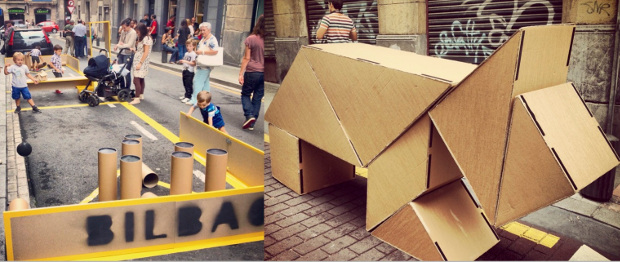
Zaramari, los organizadores del BAT, nos hacen llegar la convocatoria PLAY DAY para la concepción, diseño y puesta en práctica de intervenciones urbanas efímeras y de bajo coste que lleven el juego, por un día, a diferentes lugares del barrio de Otxarkoaga, Bilbao.

El juego es un instrumento para activar el espacio público. Una herramienta participativa y transformadora para la interacción y recuperación del uso de la calle y su disfrute colectivo. Una forma divertida y distendida para relacionarse y conocerse.

PLAY DAY es una propuesta cultural y artística. Una actividad para recuperar el juego como herramienta para la socialización y la transformación social y física de la calle. Un día para acondicionar temporalmente el espacio público y disfrutarlo de otra manera. Una iniciativa que se presenta como una respuesta frente al modelo actual de la calle para el tránsito de vehículos y personas. Una ocasión para convertir la calle por un día en un lugar para experimentar con el espacio de forma libre y creativa, dotando de espacio a la imaginación.

Si quieres saber cómo fue la edición anterior de PLAY DAY échale un vistazo a este vídeo:

Plazo de presentación de propuestas: 4 de marzo de 2014 a las 24h.
Día de la intervención: 22 de Marzo de 2014.
Dotación económica: 900€ por instalación.
Detalles de la convocatoria: Play Day Otxarkoaga

Comments: (0)

BRACKET [takes action] call for submissions

Category: ⚐ EN+convocatorias+news

Brackets [Takes action]

According to their own description, Bracket is an annual publication documenting issues overlooked yet central to our cultural milieu that have evolved out of the new disciplinary territory at the intersection of architecture, environment, and digital culture. Bracket is a project developed by InfraNet Lab, published by Actar to examine both design and theoretical positions centered on a particular theme.

The fourth issue, Bracket [Takes Action], will examine the ability of design to incite socio-political / socio-cultural action.

An extract from the call:

Bracket [takes action] asks: What are the collective projects in the public realm to act on?

How have recent design projects incited political or social action? How can design catalyze a public, as well as forums for that public to act? What is the role of spatial practice to instigate or resist public actions? Bracket 4 provokes spatial practice’s potential to incite and respond to action today.

The fourth edition of Bracket invites design work and papers that offer contemporary models of spatial design that are conscious of their public intent and actively engaged in socio-political conditions. It is encouraged, although not mandatory, that submissions documenting projects be realized. Positional papers should be projective and speculative or revelatory, if historical. Suggested subthemes include:

Participatory ACTION – interactive, crowd-sourced, scripted
Disputed PUBLICS – inconsistent, erratic, agonized
Deviant ACTION – subversive, loopholes, reactive
Distributed PUBLICS– broadcasted, networked, diffused
Occupy ACTION– defiant, resistant, upheaval
Mob PUBLICS – temporary, forceful, performative
Market ACTION– abandoning, asserting, selecting

Submission deadline: February 28, 2014 (10pm EST)
More info

Comments: (0)

#followcreative | Agrowculture, granjas urbanas en una red hiperlocal

Category: #follow+#followcreative+⚐ ES+sostenibilidad

agrowculture

De nuevo viernes, día de #followfriday por Twitter, y un buen momento para conocer gente o ideas nuevas antes de cerrar otra semana de trabajo. Hoy, dentro de la serie #followcreative, os hablamos de Agrowculture, una joven empresa neoyorkina que saca partido de las nuevas formas producción y distribución, ayudando a poner en marcha redes locales de producción agroalimentaria. continue reading

Comments: (10)

Get a Bike! | Ecosistema Urbano awarded at international cycle-friendly ideas competition in Oslo

Category: ⚐ EN+concursos+espacio público+tecnologías

Illustrasjon Get a bike

You are not stuck in traffic. You are traffic. Get a bike. Break free!

Under that motto, originally created for a commercial campaign and adbusted by Lisbon Cycle Chic, was presented Get a Bike, an international competition organized by Future Built in Oslo aiming to collect ideas about how to develop a growing cycling culture in and nearby the capital city of Norway. How to make the Oslo Region one of the best cycling regions in Europe?

continue reading

Comment: (1)

Retrospectiva: El 2013 en posts

Category: ⚐ ES+ecosistema urbano+eu:live+internet

El blog en 2013

Aprovechando el parón festivo-reflexivo de estas fechas, nos sumamos a la tradición bloguera de hacer un repaso al año transcurrido y empezar a digerir conclusiones para mejorar el que entra.

Un par de números

Durante el 2013 publicamos 137 entradas . Eso, si excluimos días no lectivos (en los que rara vez publicamos) supone aproximadamente un post cada dos días. En nuestra experiencia, no resulta fácil compaginar el trabajo en la oficina con un ritmo de publicación más alto y sostenido, al menos sin tener una persona casi exclusivamente dedicada al blog.

Haciendo un repaso rápido ya se ve que las entradas son muy variadas, desde breves noticias hasta artículos muy trabajados. Mientras que hay blogs que tienen un perfil bastante especializado, nosotros nos hemos mantenido siempre en el punto intermedio entre un blog corporativo (mostrando obras nuestras, comentando el trabajo en marcha…), uno de opinión (compartiendo artículos nuestros y de terceros) y uno de noticias.

Otra característica propia de www.ecosistemaurbano.org es que publicamos en varios idiomas. Del 2013, 88 posts son en español (un 64% del total) y 51 en inglés (un 37%), más 1 en francés y 3 en italiano, idiomas que ocasionalmente también aparecen por aquí.

Series destacadas

Llevamos un tiempo intentando organizar los posts en series temáticas, y el año pasado fue la ocasión para retomar algunas de ellas y lanzar un par nuevas. Ahí van algunas de ellas:

#followweb, #followarch – nuestras recomendaciones de los viernes, personas, grupos o webs interesantes

metamap – una serie sobre herramientas digitales de mapeado urbano, con un repaso a distintos proyectos y entrevistas a sus autores

eu:collaborators – una sección fija donde presentamos a toda la maravillosa gente que trabaja con nosotros

eu:kids – una serie comenzada este año pasado sobre ciudad, arquitectura, espacio público… en relación con los niños

A+OS – una serie antigua, recientemente resucitada, sobre arquitectura y cultura abierta, herramientas libres y open source

social toolbox – una serie largamente en proyecto pero recién estrenada, sobre herramientas digitales que actúan sobre la ciudad desde el punto de vista social

urbact – más que una serie, es una sección que mantenemos como Punto de Difusión Nacional de URBACT, con artículos, noticias y reportajes sobre las actividades de esta red europea

Para este año, sigue pendiente el objetivo de desarrollar más las series, estrenar alguna nueva que tenemos en mente, y destacarlas como se merecen en algún lugar de la página para facilitar el acceso a ellas.

Entradas destacadas

En cuanto a las entradas individuales, no es fácil elegir un criterio para seleccionarlas. El número de visitas no es siempre ilustrativo de la calidad, así que hemos adoptado un criterio más flexible: ahí van los posts más vistos y/o relevantes y/o que más nos han gustado a nosotros, sin un orden particular.

Black Rock City

Black Rock City: la ciudad temporal del burning man

pinocchio

Arquitectura participativa… ¿hijos de los situacionistas?

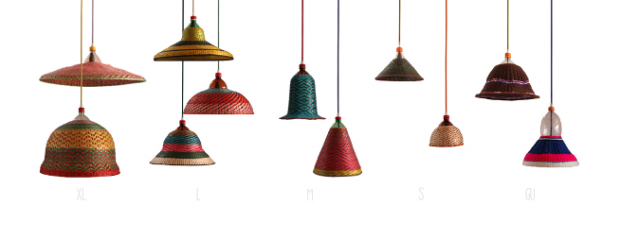
pet lamp

PET lamp | Uniendo reciclaje, artesanía y diseño

plus pool

Crowdfunding, ¿aplicado al desarrollo urbano?

Solar System muestra el potencial solar a alta resolución

Mapdwell Solar System | Mapeando el potencial solar con una precisión sin precedentes

urbact

Formación en planeamiento urbano sostenible… para políticos

CITY KIT - HYBRIDSPACELAB

Hybrid Cities and networked participatory design systems | Hybrid Space Lab

urbact

Mercados municipales: tejido local y sostenible I y II

Bicycle-Lane

Bicycle-friendly houses

Boletín URBACT noviembre 2013

Los desafíos de la planificación participativa | Resumen del II seminario URBACT en Madrid

Comportamientos responsables y arquitectura escolar

crtweet2_654

Identidades personales e identidades colectivas | cRTweet, gestión colaborativa de cuentas de Twitter

mozillajapan_654

¿Modular y open source? Indagando sobre el Mozilla Factory Space y su diseño abierto | A+OS

10843511746_fd70749a96_c_654

Huertos urbanos: un Madrid cultivable para los niños | eu:kids

Despilfarro en la cadena alimentaria

Despilfarro en la cadena alimentaria: un tercio de los alimentos van a la basura

cascina_fb_654

Cascina Cuccagna en Milán: Implicación de la comunidad, regeneración y ahorro de energía

Y por último, algunos otros posts que ilustran parte de los trabajos, logros y momentos vividos en la oficina durante este año:

EU ABOUT… ¡por fin!
Plaza Ecópolis and Ecobulevar | Dubai International Award for Best Practices
Importing Architecture | Photos from the exhibition in Oslo
Dreamhamar, finalista en la Bienal Española de Arquitectura y Urbanismo
Se busca “arquitecto catalizador”
Plaza Ecópolis, premio construcción sostenible Castilla y León
International Summer School in Sardinia
Fun as building material | Marielyst STRAND, competition proposal
Energy Carousel | eu:KIDS
Nuevo formato de boletín mensual

A partir de la experiencia que suponen todos esos posts y los de años anteriores, tenemos un montón de ideas para mejorar el blog y sus contenidos, las cuales intentaremos poner en práctica, al menos en parte, durante este nuevo año que entra… pero eso mejor lo dejamos para otro post.

Comments: (3)

¡2014!

Category: ⚐ ES+ecosistema urbano+eu:comic+eu:live

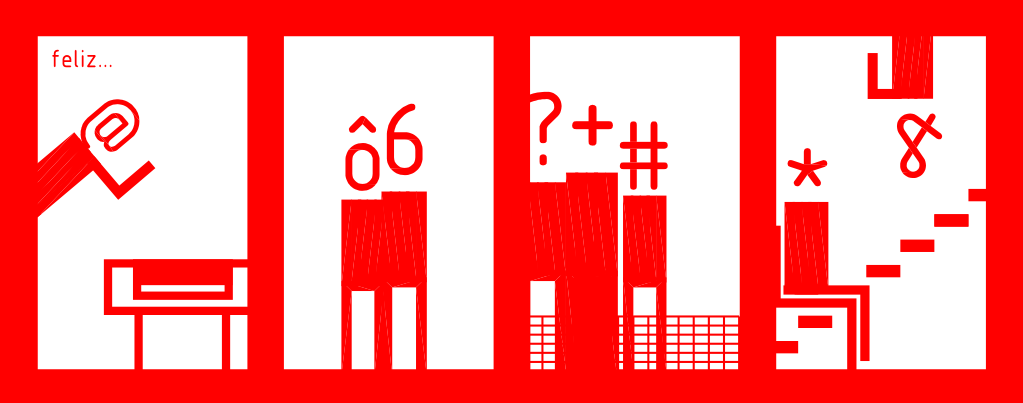
Desde Ecosistema Urbano os deseamos…

¡Feliz 2014!

… que en este nuevo año que entra podáis desarrollar ese proyecto que parece que quiere arrancar, que logréis acabar esa tarea largamente pendiente, que os encontréis con ese cliente que os va a dar esa gran oportunidad o que la forjéis vosotros mismos, que aprendáis eso que ni siquiera sabíais que teníais que aprender, y que sigáis en la brecha intentando trabajar en lo que os gusta, de acuerdo con vuestros principios y rodeados de los mejores colaboradores.

Comments: (0)

Alive Architecture | Urban installations to raise awareness and drive change

Category: ⚐ EN+creativity+urban social design+urbanism

Alive Architecture

Earlier this year Belinda had the pleasure to meet Petra Pferdmenges and know about her practice, which is close to the concept of tactical urbanism and to our way of using urban actions or ‘mockups’ to test concepts in the city and trigger engagement. In her own words:

Quick and simple urban performances allow engaging with the local population and observing their reactions towards the performed project. In case of success the tests may stimulate a dynamic that forwards the initial action, often independent of the actual designer who generated the process.

The practice

Alive Architecture, based in Brussels and founded by her in 2010, is a research-based practice that celebrates design engagement through urban actions in order to generate urban dynamics. The applied tools are performances that establish a dialogue with the local actors. The intention is to enter into a feedback loop between testing a project (the expertise of the designer) and observing the local population’s reactions (the expertise of the local population) and allows furthering the initial project. Successful projects generate a more permanent dynamic in the neighborhood.

In commissioned projects this method is applied in order to test preliminary design proposals that will then be furthered through the observation of people’s reactions. In self-initiated projects the quick and simple actions are a way to raise a dialogue on the potential of a well-chosen site through engaging with the local population.

The use of popular media as Facebook, postcards, fanzine’s or flyers supports the construction of exchange among the different actors involved in the project. The dissemination of the work in form of publications, writings and conferences may expand the dialogue beyond the local scale.

In order to give you a glimpse into her work, here is a series of projects initiated and realized in and around Brussels red light district:

Visible Invisible

Visible Invisible by Alive Architecture

Visible Invisible by Alive Architecture

Collaboration with: Stijn Beeckman, photographer
Date: December 2010 – January 2011
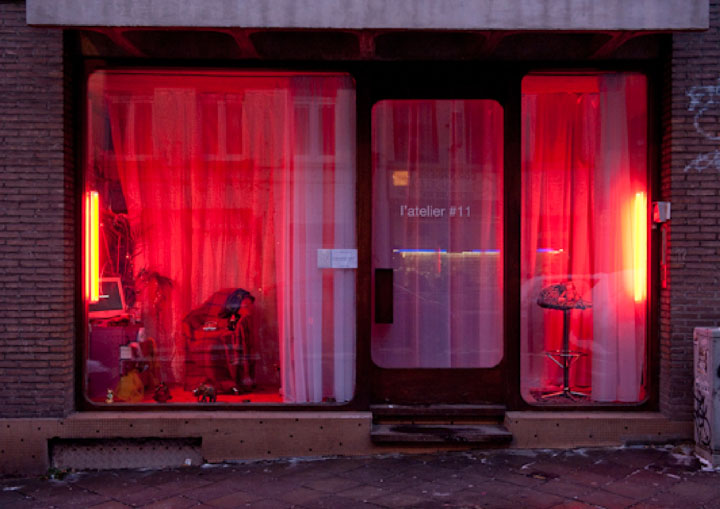
Place: Vitrine 11, Brussels (Ixelles)

The request by the owner of the gallery ‘Vitrine 11’ to propose an installation to be set up in a display window leads us to the question: ‘How to make a window display alive?’ Reflection on domesticated windows in relation to the public domain brought us to the neighborhood of the Rue d’Aerschot, Brussels Red Light District. Here, the curtain behind the window allows cutting off the private sphere from public life. We proposed a copy paste of the lived windows in the Rue d’Aerschot to the window display in Ixelles, a sophisticated neighborhood in Brussels. The space becomes transformed and used in a way that is different from the original use, and provides for an encounter of the passers-by with the topic of prostitution that remains taboo.

The project provoked reactions and dialogue among people in the neighborhood. Some people became worried about their neighborhood becoming a red light district, others taking it with humor, few calling the police and again other people to try to meet the woman that never appeared behind the window. While a ‘finissage’ a series of experts on prostitution joined the discussion and were the source of the follow-up projects in the red light district itself.

Flash-Paint

Flash-Paint by Alive Architecture

Flash-Paint by Alive Architecture

Date: March 2012
Place: Brussels (Schaerbeek), rue d’Aerschot

One of the actions to advertise the vacant spaces was realized within the street itself. The intervention was inspired by the signs hung behind many of the windows on the ground floor announcing ‘Cherche Serveuse’. The papers indicate that the place has free window space for a woman to offer sexual exchange against money. I took this as an inspiration to place additional signs saying ‘Cherche Locataire’ on the windows of the vacant spaces on the ground floor to indicate the search for people to rent the place. An email address on the sign invited people to express their interest. A small number of emails were received but the actual encounter in space was much more fruitful. Singh, the person employed to run the night shop in the street, was getting exited to have his own shop in the street. A series of immigrants without papers stopped to ask for the price and were ready to pay a rather high amount of money to rent a studio in the street. Further, potential pimps started discussions to test if the spaces on the ground floor could be rented for the function of prostitution. The method of performing within the street rather than advertising space in the surroundings was a success: the direct relation between acting in the street and discussing with people became a way to exchange with those usually impossible to engage with otherwise. Therefore the same method was applied in the third action while spending more time on it to engage more in depth with people.

As in the action Flash-Paint, the intention to occupy one of the vacant ground floor spaces within the framework of the project ‘I love Aerschot’ is furthering this project and may, in case of success, generate occupation of several vacant ground floors along the street.

Food for love

Collaboration with: Piadina Wagon
Date: April – October 2012
Place: Brussels (Schaerbeek), rue d’Aerschot

Among a series of other actions responding to people’s needs in Brussels red light district I curated a pop-up restaurant Piadina Wagon in the street. The owners sold for the duration of a day their Italian specialties in the street. On one side the installation of the restaurant that expanded onto the sidewalk had a short-term value to improve the livability of the street. On the other side we recognized the socio-economic success of the project and it became evident that there is a potential for pop-up restaurants in the street that may have a long-term impact on the life in the neighborhood. The owners of the Piadina Wagon agreed to install their restaurant once per month in the street from June to October 2012, this time including a delivery service.

Dissemination of the project through local media announced the success of the project and the dates of the presence of the mobile restaurant in the street. After several articles and announcements were published a second restaurant with the name Pink Panther arrived to sell Lebanese specialties in the street. While the Piadina Wagon stopped their intervention this November, the Pink Panther continues selling Lebanese food once a week in the street.

In the follow-up project currently developed with Escaut architectures and OKUP, a series of public dinners and breakfasts will further the idea of food places in the street and contribute to the dialogue among the different actors.

Sweet Flowers

Sweet Flowers by Alive Architecture

Sweet Flowers by Alive Architecture

Date: April 2012
Place: Brussels (Schaerbeek), rue d’Aerschot

‘I wish for better clients’ – a wish expressed by several sex workers is a challenging task for a designer. The initial idea to respond to that wish was to curate a person who would sell flowers to potential clients. The seller may give the idea to men to bring a flower when visiting a sex-worker and therefore transform them, temporarily, into better clients. It turned out to be impossible to convince any flower seller to spend an afternoon in the street as they expected the financial profit to be low in that specific neighbourhood. In order to not abandon the idea I handed out the flowers myself and became therefore not only the initiator but as well one of the actors in the event.

Several men accepted the flower and were strolling with a flower in their hand along the street. Some of the big sisters were happy about receiving a flower for free and placed them in a vase inside of the bar. Some sex-workers behind the window ended up placing a flower behind their ears. Singh, the owner of the night shop, received several flowers that he fixed between the chocolate bars in the night shop.

Recording the relational performances allowed disseminating the project through the local TV station and Archiurbain. The project generated dialog on a future of this grey and abandoned street and contributed to the call for ideas that was published end of 2012. The chosen team to realize the project is Escaut architectures in collaboration with OKUP and Alive Architecture and is currently developed and realized by the team.

People’s Wall

People's wall by Alive Architecture

People’s wall by Alive Architecture

Date: April 2012
Place: Brussels (Schaerbeek), rue d’Aerschot

‘I wish for a less grey wall’ – was expressed by several big sisters as well as people from the local association l’Attitude Nord. To respond to this wish the series of collages of the ten micro-transformations for the street were exhibited on the wall. The intention of the exhibition was to activate the wall by transforming it into a more colorful space that could create encounter, interaction and attract people from outside of the area into the street. Invitations were sent to city authorities and local associations and flyers were distributed to the big sisters and the sex-workers.

Once the performance of placing the images on the wall started some passing-by people asked questions about the work and therefore engaged into the performance. Passing by people stopped to have a look at the exhibited work, Some sex-workers sneaked out of their window to see what was happening in their street, several big sisters crossed the street to find out what the exhibition was about, a series of office workers from the two associations joined the event and a group of eight people from the city of Schaerbeek made their way down to the rue d’Aerschot.

Moments of different situations occurred on the sidewalk, each having a different density of people transforming the space. Discussions were generated between passing by people and those visiting the exhibition. At the peak moment that was at the time of lunch break a crowd of about 25 to 30 people who joined the event and transformed the sidewalk into a collective performance in the street.

In the project ‘I love Aerschot’ the project is furthered through a projection on the wall throughout the summer 2013.

Displac(d)

Collaboration with: Piadina Wagon
Date: April – October 2012
Place: Les Ateliers Claus, Brussel, Belgium

‘The three short movies ‘food for love’, ‘sweet flowers’ & ‘people’s wall’ were exhibited in the showcase of ‘Les Ateliers Claus’ in Brussels. For the opening the window became a stage for performance in which people could engage and therefore become part of the making of the event. The engagement was filmed and exhibited behind the showcase that provoked further engagement of passing by people into the relational performance.

Mapping

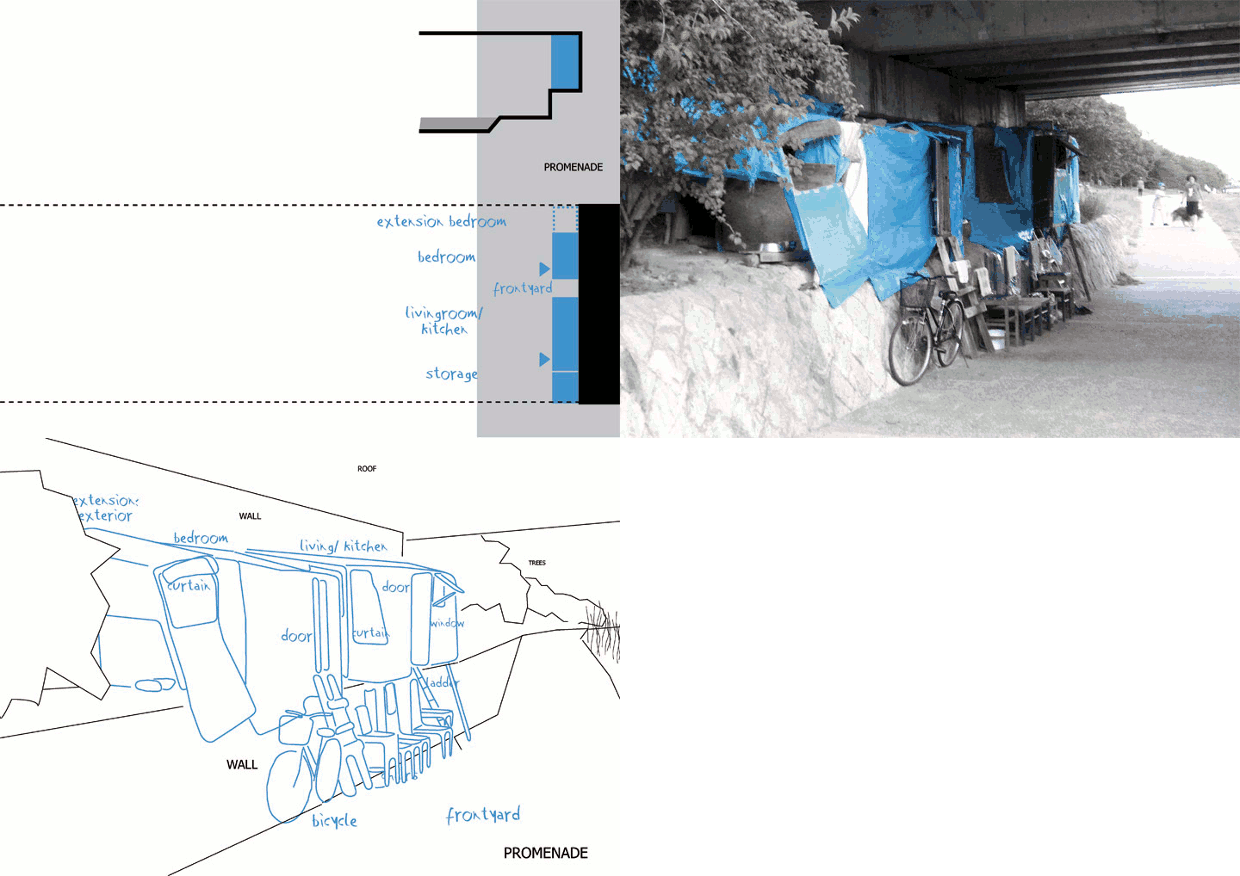
Another interesting line of work is the mapping of existing realities, in which she redraws and annotates objects and spaces, making visible the way people live, the spontaneous solutions they use and the interactions that happen around them. An great example of this is her work on informal structures built by urban nomads.

Research on urban nomads in Kyoto by Alive Architecture

Research on urban nomads in Kyoto by Alive Architecture

For more information, you can check:

Website: www.alivearchitecture.eu
Video interview (French): ARCHI URBAIN | Alive Architecture – Installations urbaines

Comments: (0)

Convocatoria de tutores IFAC | Propón un taller para el festival de 2014

Category: ⚐ ES+arquitectura+eventos+sostenibilidad

IFAC

IFAC ha abierto el plazo de presentación de propuestas para tutorizar y coordinar los 20 talleres que tendrán lugar durante la próxima edición, del 11 al 20 de agosto de 2014.

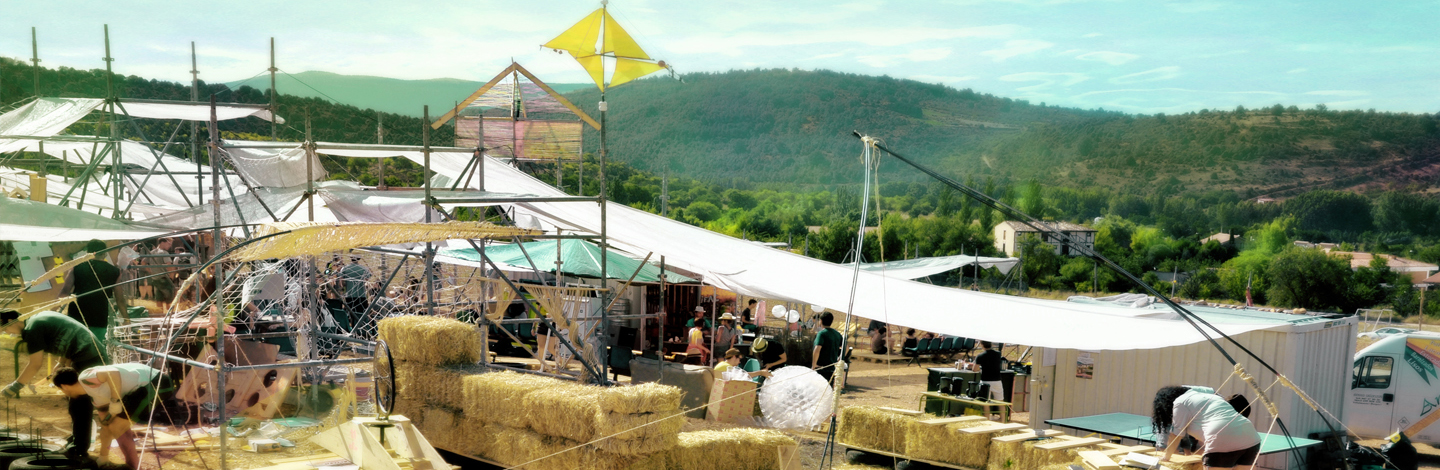
Para los que no lo conozcan, IFAC2014 es la tercera edición de este Festival Internacional de Arte y Construcción, un evento que se celebra cada verano en un pequeño núcleo rural. Concretamente, igual que la edición de este año, la de 2014 tendrá lugar en la pequeña localidad de Covarrubias, Burgos, de 650 habitantes.

IFAC

IFAC es un espacio donde se mezcla el trabajo creativo y un ambiente festivo. 300 jóvenes del mundo del arte y la arquitectura de todo el mundo conviven durante 10 días para debatir, trabajar e intercambiar experiencias, en un contexto de análisis y recuperación del mundo rural. Sus principios básicos: Educación práctica, libertad creativa y enriquecimiento colectivo.

Para haceros una idea, os dejamos el vídeo de promoción de este año:

Se han establecido cuatro tipos de taller, cada uno con un presupuesto máximo al que la propuesta deberá ajustarse:

  • Constructivo (máximo 1500€)
  • Prototipos arquitectónicos, mobiliario e intervenciones efímeras en el pueblo. (máximo 900€)
  • Artes plásticas, escénicas o audiovisuales. (máximo 600€)
  • Teórico (máximo 300€).

Para cada taller que se proponga puede haber un máximo de 3 tutores. Se valora el dominio del inglés y la experiencia o conocimiento en las técnicas desarrolladas en el taller, especialmente para talleres constructivos o con cierta complejidad.

Datos de interés:

Plazo de presentación: 22 de Enero de 2014
Más información e inscripciones: ifac.me/es/info-tutors

Comment: (1)

Mass culture: How to not die of

Category: ⚐ EN+city+sustainability+urbanism

Last summer, different cities from different parts of the world screamed through their squares and streets, and the messages from their voices revealed more than what we could see at first sight.

2013 Taksim Gezi Park by Flashstorm

2013 Taksim Gezi Park by Flashstorm

In Turkey, protests clashed initially in Gezi Park in Istanbul, where the government wanted to impose a new shopping center in the middle of the city, where a green park stood. The protests appeared trivial and useless, as the decision to build another shopping center, commonly and always justified as part of innovation and development of a country, could not compete with citizens’ willingness to keep a green area in the city center. Anyway it appeared incredible that due to this occupation, government military forces started a real fight against the ‘riots’, so that from a little episode, the phenomena started to expand to the whole country, augmenting the size of the protest and people’s involvement.

Photo by Diren Gezi Parki on Facebook

Photo by Diren Gezi Parki on Facebook

Likewise, Brazilian people began to occupy their streets in the name of stopping their Government for what they considered a waste of money and resources: the forthcoming World Football Championship. As it is known, the investment for this is a huge cost, involving the building and the re-organization of new spaces. Citizens occupied the streets asking to invest that money in more urgent sectors, as education, health and security. For sure, behind this people movements, behind their complaints and their need of being listened to, there are several dimensions of a same problem.

The ‘problem’ is that people would like to be part of a democracy, as the Governments define themselves, and have access to a democratic life, having the chance to be active part of the decisions taken. Mass culture takes part as a dimension of the phenomena. We can try to understand why and to what extent.

The context for much of the current interest in material culture is a fear. It is a fear of objects supplanting people. That this is currently happening is the explicit contention of much of the debate over postmodernism which is one of the most fashionable approaches within contemporary social science. (Miller, 1998:169)

This statement is extracted from an article where the author explains that the fear described is an overrated feeling in sociology. If we consider the Marxist position, it uses to refer to a distinction between an assumed pre-era, far from material objects, and the modern one, made or dominated by material; anyway there is actually no evidence of this historical distinction from ethnography or past studies, as even old societies were rather engaged with cultural media (Miller, 1998). However, Miller’s thought is contextualized in a different discourse, whilst the theme, that hereby is going to be explored, touches that argument in the most ‘materialist’ way possible: Indeed it will be the consideration of mass culture intended in its symbolic and representative meaning, and especially in which way the symbolic and the representative are intertwined with the material objects and massive quantitative consequences of its use as media tools.

In this case, I would argue that fear is not overrated, rather it is underestimated. Indeed, fear is real as much as deaths due to climate change and revolutions; fear is real to the extent that some people have too much and others have nothing. In this essay mass culture will be discussed from the aspect of its weight on people and planet lives, in particular inside our cities. I would try to discuss mass culture from an ethic point, not asking if we are dominated or whether there is the domination of a Western or capitalist culture, but rather inquiring if we are dominated by mass culture without recognizing its cost in terms of social justice, sustainability and depleting resources, and thus, if we could change something before crashing indirectly also due to mass culture’s effects.

Mass culture and the city

Image by AlexandraGalvis

Image by AlexandraGalvis

Mass culture is, first of all, an incredible phenomenon itself. With this term, I will refer to the huge flowering of cultural products and cultural media that surrounds our daily life, often strongly driven by markets, and that, due to the global streaming, reach masses and are consumed quite globally. Thus, it is clear that within the phenomena, arts, events, shopping and most of the rituals and media we experience daily are directly involved. Above all, mass culture has a relation with the consumerism system and technology development. Furthermore, when we talk about mass culture, we talk about a collective culture production, and thus of a result due to human interaction. (Grazian, 2010).

It is not so difficult to imagine the particular relationship that mass culture engages with cities. Not just because it is possible to observe it directly, but because cities are primarily the first concentration of masses where people live into the network of relationships, where their lives are indeed organized and intertwined within the social system. Literature supports various different traditions and points of view: For sure the city has always been seen as a great place for commercial, business, capitalist trades and often cities have been built according to these interests. For instance, Marx Weber in his classic ‘The city’ (1958) discusses it in these terms, trying to identify their main features, stressing what defines a city and what is not enough:

Both in terms of what it would include and what it would exclude size alone can hardly be sufficient to define the city. Economically defined, the city is a settlement the inhabitants of which live primarily off trade and commerce rather than agriculture.

Certainly, due to chances of trades, relationships and exchanges, the city is the realm of business. Weber also considers citizens according to their consumer role:

Similar to the city of the prince, the inhabitants of which are economically dependent upon the purchasing power of noble households, are cities in which the purchasing power of the other larger consumers, such as reinters, determines the economic opportunities of resident tradesmen and merchants.

Moreover, he claimed that:

Thus, we wish to speak of a ‘city’ only in cases where local inhabitants satisfy an economically substantial part of their daily wants in the local market (…). In the meaning employed here the ‘city’ is a market place. The local market forms the economic center of the colony in which, due the specialization products, both the nonurban population and urbanites satisfy their wants for articles of trade and commerce. (1958)

So, as a central crossroads of activities made of relationships and exchange, soon the city became the symbol of economy, gathering around itself both producers and consumers, and creating for them a whole life, including mainly rituals and tools of innovation concerning demand/buying and offer/selling. This is well explained by Jayne in his essay ‘Cities and Consumption’ (2006). He conducts an analysis about the rising of the industrial revolution, mass production and the consequent mass consumption, and the rituals of shopping and entertainment that had developed around these, collocated in the spaces of the cities, according to class distinctions, social system and capitalist interests. And mainly it is from this process that mass culture developed for the most as we know it today. Jayne stresses also how the dominant class pictured the shape of cities basically operating on the re-organization of spaces in order to respond functionally to a social meaning of class division, but also to respond to new needs of rituals primed by economic growth and capitalist fuel (2006).

It is in the first years of the 20th Century that the consumption of objects as media tools of culture in a massive style starts to be established and spread, thanks to the incentive of mass commodification and the technology advances. As it has been described by Veblen (1899), and Bourdieu later (1984), consumption and possession became icons of status. Precisely, as affirmed with the concept of cultural capital, the consumption of a specific culture and lifestyle became the symbol of distinction within the capitalist societies, where agencies and institutions worked to perpetuate the status quo (Bourdieu, 1984).

A kind of economic frame-centrism seems to exist, indeed economy is often the most considered starting point for analyzing society, as an invasive factor that defines all that it touches. Anyway, according to me, it is necessary not to forget that economy is not the only working force, because, not considering the phenomenon exactly in its whole, we risk to fall into determinism, being partial, and not seeing alternative ways of operating.

Robert Park, the major exponent of Chicago School, in 1916 talks of the city from another point of view, in my opinion also changing the vision of mass culture related. I found his words extremely interesting:

The city, from the point of view of this paper, is something more than a congeries of individual men and of social conveniences-streets, buildings, electric lights, tramways, and telephones, etc.; something more also, than a mere constellation of institutions and administrative devices -courts, hospitals, schools, police, and civil functionaries of various sorts. The city is, rather, a state of mine, a body of customs and traditions, and of the organized attitudes and sentiments that inhere in these customs and are transmitted with this tradition. The city is not, in other words, merely a physical mechanism and an artificial construction. It is involved in the vital process of the people who compose it; it is a product of nature, and particularly of human nature. (1916)

Considering that, I would see mass culture more like something belonging to the city in a virtual and potential way, then created by people and by their relations built there, and as something that is not just derived by economic forces and consumerism traditions. Again, the city characteristics assume a more human look. Park doesn’t forget the economic side and recognizes its importance:

The city is not, however, merely a geographical and ecological unit; it is at the same time an economic unit. The economic organization of the city is based on the division of labor. (…) Much of what we ordinarily regard as the city-its charters, formal organization, buildings, street railways, and so forth-is, or seems to be, mere artifact. But these things in themselves are utilities, adventitious devices which become part of the living city only when, and in so far as, through use and wont they connect themselves, like a tool in the hand of man, with the vital forces resident in individuals and in the community.

Another last important aspect:

The fact is, however, that the city is rooted in the habits and customs of the people who inhabit it. The consequence is that the city possesses a moral as well as a physical organization, and these two mutually interact in characteristic ways to mold and modify each other… (1916)

Thus, the city is first of all the space of human action and the shape and personality of its citizens. It is the place where culture and ideas flourish, as a fruit of human interaction.

Image by Oleksandr Hnatenko

Image by Oleksandr Hnatenko, www.pohtography.com

Following this pattern, we can look at analysis that see the representative idea of a city today, as the core of creativity, the essence of innovation, and the development and growth of a contemporary era. The same Richard Florida best seller ‘The rise of creative class’ (2002) contributed to expand the idea of a different city representation. Together with the ‘The creative city’ by Landry (2000), the authors indicated culture in its whole manifestation as the best creativity booster factor to attract the main potential resource of innovation: creative people.

By the way:

Hall unfolds a very important aspect of urban creativity, i.e. the people involvement. In fact, in the view of many scholars concerned with popular culture, people are not only passively consuming goods, as ‘mass’, they are also creatively determining the production and circulation of culture (Chambers, 1986; Fiske, 1989a, b) and shaping accordingly their view of the city. (Botta, 2006)

Mass culture could be seen as created, influenced, inspired by and consumed in the cities. But, in a double way, the same city is protagonist of mass culture, of narrative and imaginary, recounted and repurposed as representative of an idea of the city itself.

Mass culture, consumption and sustainability

Once the interrelationship between city and mass culture has been observed and after having stressed how there is not an only way to intend this liaison, we could now focus on the weight of mass culture. This weight could seem invisible to most, in first place because they don’t want people to see it, and then because people don’t want to see it either. Indeed, I am talking of a complex plot process among mass culture, consumerism and mass consumption, something that concerns deeply our ‘normal’ representation of daily life, as the best life possible.

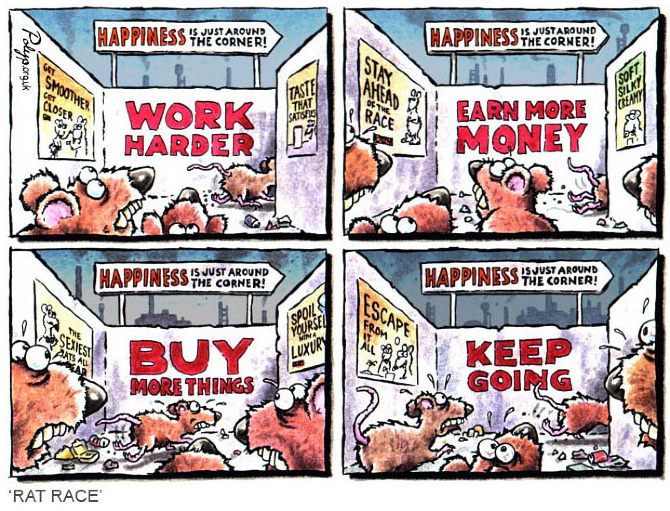
Every day we get up and go to work. We work to earn money and with that money we buy everything that can permit us to conduce a comfortable life, possibly happy, healthy and rich. The more we work, the more we earn, the more we want to have. Having objects, first of all, does not imply them to be stupid ones. We love design, we love to show off concern for our culture: So we fill our houses with books, compact discs, vinyls, vintage pieces, clothes, shoes, cars. We love of course an independent big house with all comforts, hot in winter and cool in summer. We love culture, we love style and good food, we love travelling around the world, we love a comfortable life, we love shopping. We love sports, we love concerts and dancing. And above all, we love doing everything in a single very amusing and cozy place: a big city that can offer this and more.

That above seems almost one of those pictures or statements that we can commonly find on the teenager’s timeline on Facebook. A real statement about ideal life underpinned by mass culture. Unfortunately it is a sad reality if observed under another point of view. I regret to communicate that our planet is not big nor rich enough (not anymore) to grant the same treatment to all the teenagers of the world. I am sorry to communicate to my friends that their passion to collect rock compact discs is increasing the garbage that someone else will probably find as plastic junk in the sea. I am sorry to communicate to citizens that our big cities are not going to be livable anymore if the presence of toxic gases will increase. I am sorry to communicate that while your favorite an-alcoholic drink brand, Coca Cola, launches its new advertise, assessing their will to help people and make the world a better place, with children singing in the background, in India their factories are exploiting the country’s water resources to produce their drink and the company is collaborating with Government to privatize the same water, taking it away from people.

Image seen in Global Environments & Societies wiki

Image seen in globalenvironmentssocieties.wikispaces.com

It is not easy put in discussion the best lifestyle possible people’s idea: but it is time to really face the cost of our lifestyle, and our lovely mass culture. Maybe mass culture has become a natural part of our life that it is really difficult try to reason on it in terms of sustainability for the planet in which we live, the only one. This is because mass culture currently concerns almost all the rituals of our everyday life, including education, cultural capital, identity, wealth, traditions, and all the ‘soft’ symbolic part turned on rituals.

Anyway, at this point, it could be useful to make a distinction. For me, when we talk about mass culture we are not talking just and necessarily of consumerism, but perhaps more of rituals and activities that are deep-rooted within the consumerist society; this has then for sure been emphasized to an excess, in quantity and in stimulation and expansion of people’s needs. Indeed, Chandra Mukerji (1983) has historically described examples of consumer culture in the 15th Century Europe, where the exchange of media culture, such as books, exotic pieces from far places, jewels, spices and textures, was usual among royalty and upper classes (Wilk, 2002). Moreover, Peter Corrigan argues that the concept of ‘fashion’ was already well known in the Elizabethan times, when London was the center of trends (1997).

Today the modern consumption and the consumerism culture has achieved an exaggerate level of production of goods, if not waste. We could think that the human nature aims to have as much as possible or that being greedy is a natural component of human behavior; instead it is fairly reasonable that not in all societies, in the past nor now, people have the same need of possession, nor the same notion of richness or comforts. Nowadays, we can also say that not even the whole population belonging to the same society has the same notion of values in life and of our cities. Coming back for a moment to Turkey and Brazil, it is clear that a great number of people doesn’t agree with their Governments about which are the priorities for a good life in their cities. Could another shopping center create better conditions for people or enrich people more than a green space? Could a world event solve the social basic issues of inequity and poverty of a country? People are recognizing more and more that what is really important for their cities are adequate spaces for themselves, where they have the chance to choose their rituals or maybe to create them.

We are in a cyclic system that resembles a treadmill, where the whole society is involved, into the process of producing needs, old and new, and then producing goods. The index to indicate the level of wealth and growth is the GDP that measures the quantity of goods – products in one year per country. Is the huge quantity of goods produced seriously making our societies better and prosper?

Whereas mass culture (or mass cultures) is made of tools, symbols, icons, practices, rituals and it is something concerning people and their consumption in a certain way, what distinguishes pure consumerism today is: The quantity of goods produced; the stimulation and the expansion of needs; the pushing, by few stakeholders, of society towards consumption and possession. For sure marketing and selling strategies have always done a good job to lead practices, rituals and symbols around their products.

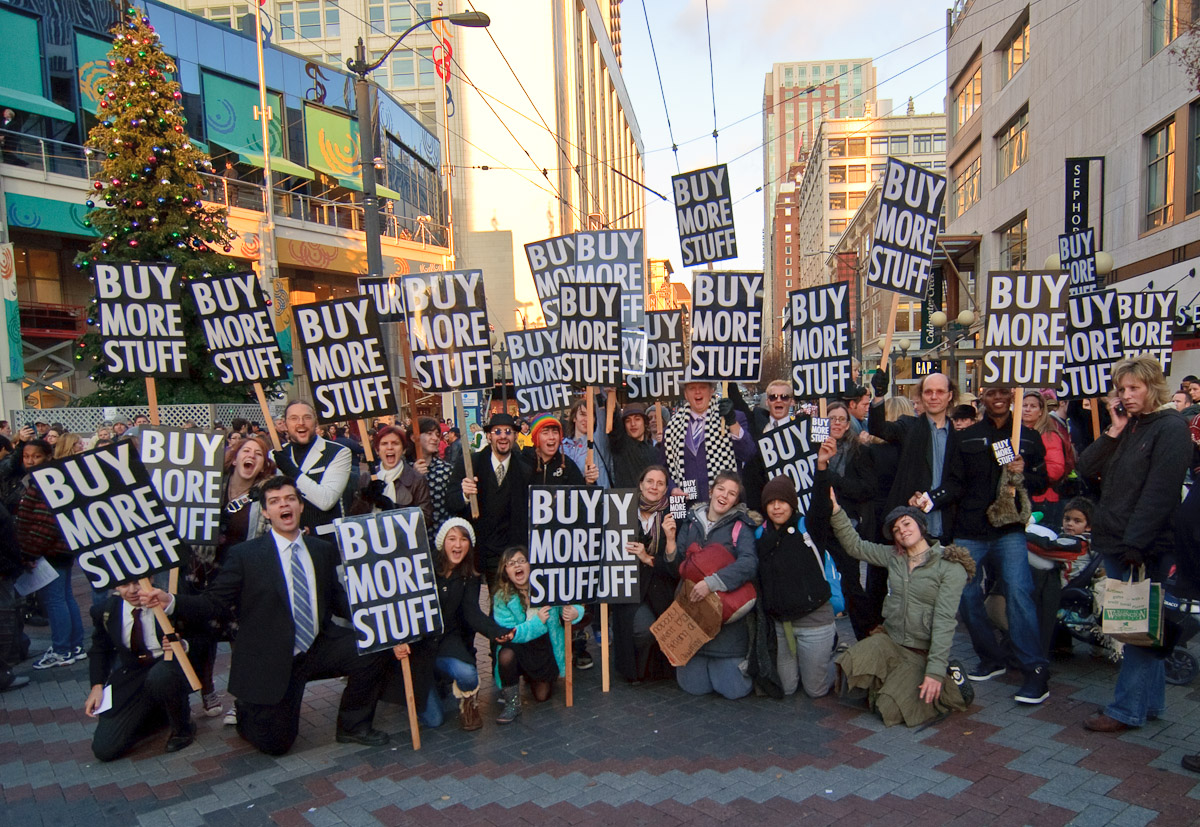
Buy More Stuff, Black Friday 2009 - Photo by Michael Holden

Buy More Stuff, Black Friday 2009 – Photo by Michael Holden

Consumerism affects mass culture so much that is primarily a mean of identity and interaction with others, because historically our Western capitalist societies consider money and the quantity of goods as distinctive symbols of wealth and success in life. Sure is that, the existence and the use of mass culture both suffer this deal. But in a society where we are conscious of the issues concerning the exploitation of resources and the return of it under the shape of garbage and where the first value is keeping safe life conditions, mass culture could change look. Already now we are adhering to style trends for smart cities, car sharing, waste recycle and other practices, that if inserted as pieces of mass culture into our lives could help to change mass culture too.

Thus, we cannot just criticize our consumerism society in terms of the damage that we are causing. We should start to reflect on our daily cultural practices, which are indeed made of mass cultural media tools, starting by city spaces, where our activities are concentrated and where more than other we could see the rituals and the proliferation of mass culture. And thus, we should begin thinking of a new approach based on them. I am persuaded that we could indeed change mass culture through mass culture itself.

According to the anthropologist Margaret Mead, there is no single approach working successfully in every society; rather, each one has a “culturally appropriate” approach, concerning the specific characteristics of its individuals (1953). In this perspective, Wilk argues:

They imply that no single set of solutions, technological, legislative, or cultural, is going to work in every society. On the contrary, we should expect great diversity in the ways different countries and cultures deal with sustainability problems. How can we expect things to change in the countries that presently consume so much more than their share of global resources? (2002)

When we talk about cities, we then talk about mass culture too, thus maybe cities could live by a different mass culture. As the city has been the protagonist of growth of mass society and mass culture of consumerism, it could also happen that the city may see the birth of a new and fairer society. Indeed, change should begin from here, from the set of organizations and citizens, in creating different rituals and use of the spaces.

Image by Starkart

Image by Starkart

Bibliography:

Bourdieu, Pierre. 1984. Distinction: a Social Critique of the Judgment of Taste, trans. Richard Nice. Harvard University Press.
Corrigan, Peter. 1997. The Sociology of Consumption: An Introduction. London: Sage.
Florida, Richard. 2002. The Rise of the Creative Class. New York: Basic Books.
Grazian, David. 2010. Mix It Up: Popular Culture, Mass Media, and Society. New York: W. W. Norton & Co.
Jayne, Mark. 2006. Cities and Consumption. New York: Routledge.
Landry, Charles. 2000. The creative city. New York: Routledge.
Mead, Margaret; World Federation for Mental Health. 1953. Cultural patterns and technical change. Ann Arbor: University of Michigan Press.
Miller, Daniel. 1998. “Coca Cola: A Sweet Black Drink from Trinidad.” Pp. 169-187 in Material Cultures: Why Some Things Matter, edited by D. Miller. London: UCL Press.
Mukerji, Chandra.1983. From Graven Images: Patterns of Modern Materialism New York: Columbia University Press.
Park, Robert. 1916. “The city: suggestions for the investigation of human behavior in the urban environment” Pp. 90 -130 in Classic Essay on the Culture of Cities. New York. 1969, edited by R. Sennett. New York Appleton-Century-Crofts.
Weber, Max. 1958. “The City.” Pp. 23-46 in Classic Essay on the Culture of Cities. New York. 1969, edited by R. Sennett. New York Appleton-Century-Crofts.
Wilk, Richard. 2002. “Culture and Energy Consumption” Pp. 109-130, in Energy: Science, Policy and the Pursuit of Sustainability, edited by Robert Bent, Lloyd Orr, and Randall Baker. Island Press: Washington.
Veblen, Thorstein. 1899 [1973]. The Theory of the Leisure Class. Introduction John Kenneth Galbraith. Boston, MA: Houghton Mifflin.

This is a guest article by Simona Ibba (@PenniLeyn). Thanks, Simona!

If you want to get your own article published, see this.

Comment: (1)

Energy Carousel | Segundo premio Taipei Design Award 2013

Category: ⚐ EN+⚐ ES+city+ciudad+competitions+concursos+design+diseño+espacio público+sostenibilidad+sustainability

ENERGY-CAROUSEL10

Hoy tenemos el placer de comunicaros que Ecosistema Urbano ha recibido el segundo premio del Taipei International Design Award 2013, con el Energy Carousel en la categoría Diseño de Espacio Público.

continue reading