


We are very pleased to announce that our Master Plan proposal for the revitalization of the Historic Downtown District of Asunción, Paraguay (Plan Maestro del Centro Histórico de Asunción), in an international open competition held in the past months. We are surprised and thrilled with the great reception that the project has had, and eager to continue its development side by side with the people, the organizations and the institutions in the city.
⚐ EN
August 6, 2014
MyPS: see below
Earlier this year we introduced to you #networkedurbanism, now that the “studio report” book is almost ready, we are publishing a series of posts showing some of the projects that the students have developed during the 2010, 2012, and 2013 studios at the GSD.
In this last #networkedurbanism post we present to you three projects held together by the common thread of time. The first one deals literally with our personal time organization, the second with the transmission of memories tied to a specific place, and the last with the the permanence of personal memories through time and beyond life. continue reading
July 28, 2014

Hyper activated place of connection – Table Talk
Earlier this year we introduced to you #networkedurbanism, now that the “studio report” book is almost ready, we are publishing a series of posts showing some of the projects that the students have developed during the 2010, 2012, and 2013 studios at the GSD.
In this sixth #networkedurbanism post we present to you two projects that apply the concepts of a social network, like the ones that we generally use—twitter, facebook—to the physical world using digital locally-targeted apps or physical objects. continue reading
July 23, 2014

Earlier this year we introduced to you #networkedurbanism, now that the “studio report” book is almost ready, we are publishing a series of posts showing some of the projects that the students have developed during the 2010, 2012, and 2013 studios at the GSD.
In this fifth #networkedurbanism post we present to you two projects that share the aim to enrich the physical space with a digital layer, the connection between real and virtual worlds was one of the recurrent themes in the studio and these two projects truly create a strong link between them allowing people to express their opinion about the physical city using digital means. continue reading
July 15, 2014

My Little Public – See below
Earlier this year we introduced to you #networkedurbanism; now that the “studio report” book is almost ready, we are publishing a series of posts showing some of the projects that the students have developed during the 2010, 2012, and 2013 studios at the GSD.
In this fourth #networkedurbanism post we present to you three projects focused on social issues and placemaking, their main goal is trying to involve the local communities in the construction process of the future of the cities. continue reading
July 9, 2014

Voronezh—which became popular in the late 80s because of a controversial UFO incident—is a city of over 1 million inhabitants, situated 500 km south of Moscow. It is located on the banks of the Voronezh River, which in 1972 was transformed into the Voronezh Reservoir or “the Voronezh Sea” as it is called by the inhabitants —a huge lake, 30 km long and 2 km wide. You can read more about the history of the reservoir here.
During the following decades the population enjoyed the cool water during the hot Voronezh summer, but in 1992 the authorities labelled it as “not fit for swimming” as a result of the increasingly polluted water.

Click on the image to see some cool panoramas of the Voronezh Sea!
The Department of Natural Resources and Ecology of the Voronezh region recently decided to organize a competition in order to develop a strategy for the future of the Voronezh Reservoir. The competition consists of two parts:
- An Open Ideas competition meant to gather ideas that show the potential of the lake for urban and nature development.
- A Closed Competition for teams of landscape architects, urbanists and ecologists that should combine ideas about possible future uses of the lake with technologies for cleaning it up. The strategy should include both a project and proposals for implementation.
We are glad to communicate that we have been selected among the four finalists of the closed competition. Over the following weeks we will be working hard on putting together a creative approach and a comprehensive strategy in a great presentation. More news soon!
Related link: Report of the jury
July 8, 2014
Today we introduce you to Claire Cassanet, a young landscape engineer who just left the office after four months of internship. We worked and learned together, we cooked together, we enjoyed every day in her cheerful company. We already miss you, Claire! Read on as she describes her experience with us…

Claire!
July 7, 2014

Earlier this year we introduced to you #networkedurbanism. Now that the “studio report” book is almost ready, we are publishing a series of posts showing some of the projects that the students have developed during the 2010, 2012, and 2013 studios at the GSD.
Today’s three projects are focused on the knowledge—or the lack of it—that we have of our environment and the resources we use. Believing that many poblematic behaviors we have are caused by our low level of awareness, these projects try to find a way to communicate effectively their content and to initiate discussions and reflexions which may eventually lead to environmental improvements. continue reading
July 4, 2014

In 2009 we had the pleasure to lead the final thesis projects of a group of international students taking the Master in Advanced Architecture at the IAAc —Institute for Advanced Architecture of Catalonia.
Among them, we met Kalpit Ashar, who developed as final thesis a project in his home city Mumbai, dealing with informality and social processes. I am happy today to introduce you to the work of MAD(E) IN MUMBAI, and the office established by him together with his partner Mayuri Sisodia. In their own words:
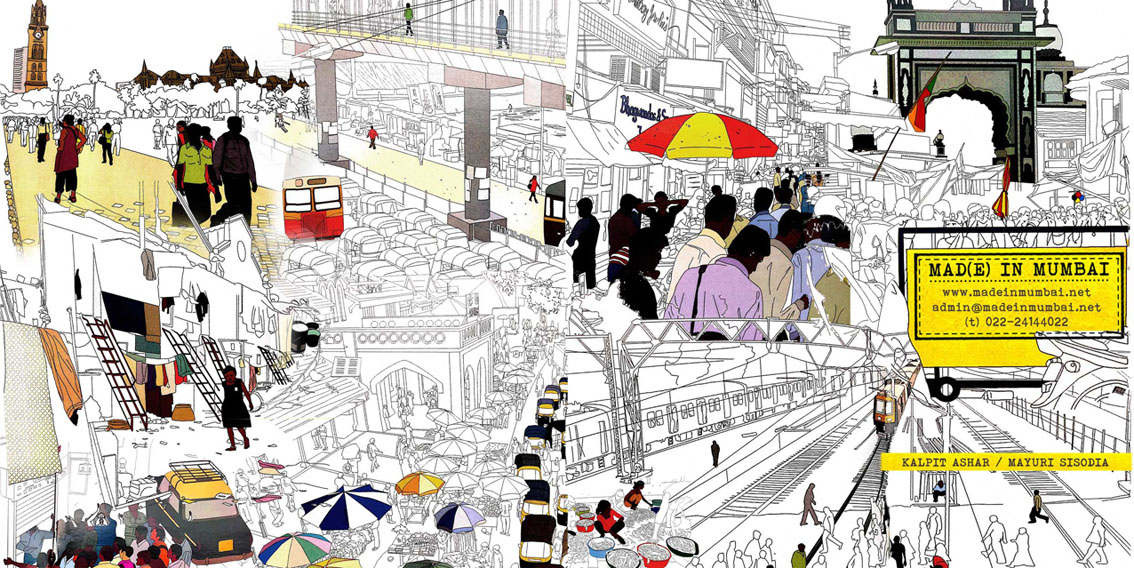
Image: The Mumbai Report
The office provides comprehensive design services in the fields of public institutions, high density housing, environmental infrastructure, community design, landscapes and territorial planning. MAD(E) IN MUMBAI takes its shape in the madness of Mumbai city. This crazy patchwork of ideas, experiences and materiality becomes a repository and laboratory for the studio. It is a departure point for its speculation and practice.


Urban repository – Images: Mayuri Sisodia, Jacob Wilson and Ming Deng
They work closely with the chemistry of the city to discover potential fields of operation. The belief of the practice lies in looking beyond the visible for the unseen and for absurdities of things and places.
Together they have won many national and International design competitions which include Flood resilient Housing Design for Gorakhpur, Revitalisation of Banganga Crematorium, and Regional cultural centre for sustainable community by IAHH and Kalanagar traffic junction Urban Design competition by BMW Guggenheim lab.

Aqueous commune, flood resilient habitats in the city of Gorakhpur
For example, Aqueous communes are flood resilient habitats in the city of Gorakhpur, a city in mid-Gangetic belt. They are Community built initiations that accommodate changing rhythms of Rapti river and make them part of everyday life of its inhabitant. They change imagination of water from an enemy to a friend and celebrate it and make peace with it through design. These aqueous communes multiply along the landscape to contribute to its resilience and develop into an intimately stitched neighbourhood.

Other works by Mad(e) in Mumbai
July 3, 2014

Como os contábamos en un post anterior, hemos actualizado www.ecosistemaurbano.tv, nuestro canal de vídeos sobre sostenibilidad urbana, integrándolo con nuestro canal de Youtube. Aprovechando esta circunstancia, vamos a rescatar una serie de vídeos, principalmente entrevistas, que hemos re-descubierto y que aún nos parecen interesantes a día de hoy.
Hoy os traemos las respuestas de David Harvey a nuestras preguntas cuando, en octubre de 2009, le preguntamos su opinión sobre el concepto de sostenibilidad.
Harvey es uno de los grandes de la geografía moderna, un pensador e investigador de referencia, con un posicionamiento claro contra las desigualdades e injusticias generadas por el sistema capitalista. Precisamente con una de nuestras citas favoritas de David Harvey comenzamos el artículo Network Design: Dream Your City que publicamos hace poco en la Harvard Design Magazine:
El derecho a la ciudad es mucho más que la libertad individual de acceder a los recursos urbanos: es el derecho a cambiarnos a nosotros mismos cambiando la ciudad. Es, de hecho, un derecho común más que uno individual, ya que esta transformación depende inevitablemente del ejercicio del poder colectivo para reformar los procesos de creación de ciudad. La libertad de hacer y rehacer nuestras ciudades y a nosotros mismos es, sostengo yo, uno de los derechos humanos más valiosos y olvidados.
Es asombrosa la validez casi profética de lo que dice en esta entrevista en concreto, especialmente viendo cómo ha evolucionado el panorama desde entonces. En esta breve entrevista Harvey enlaza la sostenibilidad con la necesidad de emprender proyectos de transformación desde la sociedad civil, llamándonos a actuar desde esa posición:
Mi mensaje es: Pensad en ello, activaos, empezad a trabajar de verdad con los movimientos sociales porque de ahí es de donde van a venir los cambios.
En estos 5 años han sucedido muchas cosas —Primavera Árabe, #15M, #occupy, etc— que confirman la importancia del impulso social como lo veía Harvey: como elemento regenerador de la sociedad y su posicionamiento en relación con el mundo.
Sin más, os dejamos con el vídeo —subtítulos en español incluidos—, ¡disfrutadlo!