Review of the paper “Urban land teleconnections” by Karen C. Seto, Anette Reenberg, Christopher G. Boone, Michail Fragkias, Dagmar Haase, Tobias Langanke, Peter Marcotullio, Darla K. Munroe, Branislav Olah and David Simon.
Recently a research paper was published in Proceedings of the National Academy of Sciences (PNAS) concerning the conceptual development of global sustainability, in relation to both urbanization (urban sustainability) and land change. The paper argues that land change and urbanization dynamics are explicitly connected, and suggests “urban land teleconnections” as a new framework for dealing with global sustainability.
“We propose urban land teleconnections as a process-based framework for integrating urbanization and land change, for revealing their linkages and pathways across space and time, and for identifying potential intervention points for sustainability. Through the lens of urban land teleconnections, new and surprising diverse urban forms and processes, such as periurbanization, can be better understood and foreseen. The urban land teleconnections concept could also be useful to the wider research community to anticipate implications for global land resource use.”
More and more people live in the cities. The increasing urbanization is raising many discussions about sustainable planning, and this recently published paper feeds the debate with new inputs. Encouraging a reconsideration of the terms on which we base sustainable policies, the research is widening again our perception of the relationship between the urban field and land. The term “teleconnections” refers to climate science, where it is understood that events have impact over large geographic areas – when the waters of the North Atlantic go through a warm phase, fire incidents increase in the western United States. Just such urban land teleconnections explain the interrelation and invisible bond between urban processes and land use processes, which we must consider when planning our sustainable future. The key to develop strong sustainable planning, is to stop thinking of urban sustainability and land use sustainability as limited to local scale and place, and instead start to take into account the processes and global connections merging urbanization and land use.
“The virtual shrinking of distances between places, strengthening connectivity between distant locations, and growing separation between places of consumption and production are emerging topics in “telecoupled” human–natural systems and tropical teleconnections of deforestation […] In an increasingly urban world, characterized by global flows of commodities, capital, and people, where land that provides goods and ecosystems services for people is becoming more segregated from the space of habitation, teleconnections captures links between distant processes and places, and can be used to explore consequences of urbanization and land changes at great distances from points of origin that would otherwise go unrecognized.”
Urbanization and land change have so far been treated as parallel processes. Apparently this has limited the progress of the concept of sustainability. The paper states that a simultaneously treating of urban sustainability and land change as interwoven, non-separable processes is the keystone to advance in developing sustainability:
“The magnitude and accelerating rate of contemporary urbanization are reshaping land use locally and globally in ways that require a reexamination of land change and urban sustainability. Worldwide, urban populations are projected to increase by almost 3 billion by 2050 and the total global urban land area by more than 1.5 million square kilometers—an area three times the size of Spain—by 2030. Urban economies currently generate more than 90% of global gross value added, meaning few rural systems are unaffected by urbanization (3). Given such trends, we must reconsider how we conceptualize the many connections and feedbacks between urbanization and land change processes.”
The paper is confronting three understandings of the urban – land relationship that so far have been key themes in sustainability policies.
One is the Land Classification Systems, on which the paper states:
“By definition, because urban is human-dominated, urban areas “appropriate” natural ecosystems, ecosystem services, and natural capital. By this logic, urban cannot be natural capital. However, such a conceptualization contradicts underlying principles of urban ecology as well as sustainability.”
The second theme is Place-Based Definitions:
“The place-based conceptualization enforces the idea that urban sustainability requires urban self-sufficiency. […] However, decisions and behaviors that are local or even regional in scope do not account for critical consequences of teleconnections, which may undermine sustainability efforts at great distances or influence the overall sustainability for the entire system. Eating locally might undermine livelihoods of distant farmers who may be using less energy-intensive methods to produce food than local growers. Put another way, sustainability initiatives often focus on the importance of place while ignoring the processes of urbanization that may have farreaching effects on distant places and people. These processes can generate uneven and undesirable outcomes that may be undetected when focusing solely on place.”
On the third theme, Land Transitions, the paper argues:
“[…] Although not always explicit, a common assumption is that land transitions in Europe and North America can help understand future trends in Asia, South America, and Africa. Such assumptions disregard the realities that cultural differences influence conceptions, codifications, and uses of space and land, and that use of distant land to meet demand for local populations can significantly alter the pathways of change. As a result, there is no universal or linear transition process; phases identified in one context can be shortened, prolonged, overlapped, or even omitted or transgressed elsewhere.”
Urban Land Teleconnections is suggested as a new key theme, a framework to address sustainability. In an immediate invisible network, urbanization and land change are constantly in a process of affecting one another. The term itself indicates that the concept of sustainable urbanization and sustainable land use has merged. Conceptualization of sustainability should contain both processes at once.
“By using an urban land teleconnections framework, we move away from conceptualizing urban sustainability and land as attributes specific only to a place, to begin to link dynamic global processes to their spatial “imprint”.”
This means that changes in nonurban places affects urban places and that change in urban space affects nonurban space. In this way, urban and land relations are interwoven in a global network wherein neither the themes Land Classification Systems, Place-Based Definitions nor Land Transitions can stand alone to define the framework for developing sustainable concepts.
“ […] we can study multiple urban regions jointly, rather than trying to aggregate and generalize across many disconnected sets of case studies, and consequently provide a more organized way to integrate knowledge globally. A more holistic analysis of the underlying and spatial effects of production, consumption, and disposal will enable development of policies that promote viable and fair solutions, and ultimately global sustainability.”
Today I want to share an article that was previously published in Studio Magazine. On this occasion, I would like to thank their coordination team for inviting me to join their first release.
Summary /Overview
Traditional media don’t broadcast what the citizens are debating or organizing on a daily basis. Nevertheless, thanks to Social Networks, people can receive information and interact in real time with others, taking part in debates and social movements; and the 15th of May in Spain is an example of this.
This new information ecosystem reduces the influence of the mass media and slowly forces local authorities to relate to citizens in a more direct and horizontal way.
This is a great opportunity to generate a new “social control” model, pushing local authorities to take public opinion into account.
The digital media offers a broad environment for communication so that the organisation of any given action is greatly improved; everything becomes decentralized while simultaneously connected and synchronized.
On the urban scale, we speak of the “Sentient City”, a model based on a technological/social ecosystem, where knowledge, collective actions, and interactions between individuals and groups are encouraged, taking advantage of the new possibilities offered by hybridizing physical and digital layers.
In reversing the supremacy of centralisation over individual actions, citizens can become aware of their power and organize themselves on the web.
We have the necessary technology, knowledge and dynamics to put in place more open processes of urban administration and management. Citizens have already started to move; and although public administration could take advantage of such independent and autonomous processes to deal with complex situations, it appears that a clear political will is still lacking.
The fragmented city
Today, the dimensions of time and space, which were historically strongly linked in a space-time continuum, are increasingly growing apart and becoming independent, in a fragmented spatial perception. Nowadays a large number of people are moving from one point to another of the city to reach their workplace, and go back home. The distance between these two points (spatial dimension) and what happens between them does not affect or interest these people in any way. Indeed, the only thing people are concerned with is the duration of the trip (time dimension).
The city is no longer a continuous place, but a structure of nodes connected in a network (network city). These nodes become increasingly more defined, organised and efficient and, the journeys between them shorter and faster thanks to technical progress. The spaces of a city that have no particular characteristics and a unique function, that is to say everything that is not a node, loose significance, including public spaces.
In such city – the “fragmented city” – we use low cost technologies (internet, telephone and transport) to move, to manage our social relationships, and to communicate with people with whom we don’t necesarilly share a common physical space like a neighbourhood.
Very often the complexity of one point exclusively consists in giving access to other points, hence the importance that movement has acquired today. Instead of living in a continuous space, we continuously move between discontinuous spaces (points or nodes).
This networked structure, unlike a continuous structure, reduces diversity and complexity. The less diversity and complexity, the greater the need to move. Every point has its function and identity. Everything seems more organised and easier to find. However, to find what we are looking for, we are compelled to move constantly to other nodes.
The majority of these journeys are done by means of transport, at a speed that does not allow any relationship with the surroundings. There is a starting point and a finishing point, with little opportunity for a surprise or a change. All this implies an impoverishment of the intermediate spaces, spaces that link different points: places are consequently public spaces.
In order to transform these kinds of cities, it is essential to intervene in everyday aspects of life which might appear to have no relationship with the design of public spaces in urban areas.
Our lifestyles are two dimensional: in situ and virtual. Now we are able to intervene in the new dimension, what we commonly call “virtual” or “digital”, . As the sociologist Manuel Castells says “Everything we do, from when the day begins until it is over, we do it with internet […] the connexion between in-situ (not real because reality is virtual and in situ at the same time) and virtual is established by us. There are not two different societies, there are two kinds of social activities and relations within ourselves. We are the ones that have to search the best way to arrange and adapt them.
According to Daniel Innerarty, in the city the homogeneous and non changing area is nothing more than an extreme case within a global area of connected local multiplicities. Instead of neighbourhoods, local networks are developed, and public debate takes place in a virtual area. In this scenario, streets and squares have ceased to be the main meeting areas.
Internet seems to offer an alternative “space” for social relationships as compared to “traditional” spaces. This can be seen as a problem leading to empty public spaces; or on the contrary, it can be considered an extraordinary opportunity to strengthen social relationships by creating the necessary budgets to improve the vitality of public spaces. Today the Internet is the “place” where community models of management are being experimented.
I believe it is important to reconsider the city as something built by everyone, and to see public areas as the ground where this process can take place. Today we have tools available that are able to act as a catalyst for participatory dynamics that were previously impossible to coordinate. There are increasing examples of processes of creation by citizens, linked to the use of new technologies. It is undeniable that Internet is a key factor contributing to changing the society. That being said I believe it is obvious that we cannot think of public space without taking into consideration the potentialities of these technologies, how they are used and how they can be an added value.
We should begin to talk about a new type of public space, a hybrid space, where technology could become a catalyst for hybridising dynamics between activities that are not traditionally connected or that are located in other (private) spaces.
Juan Freire explains this clearly: “The differentiation between spaces and physical and virtual communities is outdated. We are witnessing a hybridising process which modifies our individual identities, communitarian and territorial. Internet has contributed to the development of global networks, but paradoxically it has had a less noticeable influence in local spheres. However, digital technologies modify radically the way in which we are organised and we relate to our environment so we are already living in territories where the digital realm is as important as the physical. The hyper-local networks and hybrid public spaces are the new realities which we confront with the advent of Internet and digital culture in our local environment”.
According to Juan Freire the crisis of public (physical) spaces in urban areas is also due to the lack of (open) design, giving the citizens, once more, the opportunity to take a real interest in its use. It has also brought into debate concepts such as “hybrid spaces”, to refer to the opportunities that the hybridising of the physical with the digital sphere offers in public spaces.
We can grant the assumption of the existence of a digital skin that characterizes public spaces and devote ourselves to defining its qualities and characteristics. Instead of “hybrid” I like to use the concept of “sensitive”. “Sensitive space” refers to the “living” character of these spaces; to their capacity to promote a two-way relationship with its users, to catalyse hyper-local social networks and to visualise information related to the environment in a transparent manner.
If we analyze the increase in the use of social networks on the Internet we realize that we are witnessing a process of change that will lead to the disappearance of the current dissociation between digital and in-situ identity.
Most people can continue living in complete normality without having to take care of their digital (identity) presence in social networks. Nevertheless, it is highly probable that in a few years time the concept of identity will inevitably integrate both the digital and the physical dimension. Consequently, each person will be forced to take as much care of their digital identity as of their physical identity, something that many people have been doing for some time already.
We must take several specific factors of this new kind of identity into consideration such as its peculiar time dimension. The building process of the digital identity over time leaves a footprint on the web, a visible footprint that is accessible to any user. The end result is an identity that is perceived as a sum of the past (footprint) and present identity.
Generally we control our public image by showing at each time only what we wish. However, when our identity leaves a footprint on the internet, we no longer have exclusive control over it but it is shared amongst friends and acquaintances (namely the peer group).
Each person that knows me can publish information (photographs, texts, etc…) that are directly or indirectly related to my identity without the need of my approval. This is what happens in most of the social networks.
Certainly, my digital identity will be entirely integrated in the learning process and will be increasingly associated to a physical space; that is, the idea we had about a parallel digital identity that is detached from reality does not, I think, interest anyone: in fact we do not even have time to create parallel identities.
Our identity is not only formed by way of the information that my friends and I have published, but also through the information that my devices publish. An example could be the use of services like Foursquare that allows me to upload posts in my social networks about my location at any time, taking advantage of the internet connection of our mobile phones.
To explain this phenomenon Tim Berners-Lee mentions Giant Global Graph, this means, the future Semantic Web with which we shall go from gathering the relationship between people to focus on the relationship between people and their interests (documents). Thus, if the “Internet” has allowed us to connect computers and the “Web” has allowed us to connect documents, then the “Graph” will allow us to link the documents (places, objects, etc.) and the people. So we could define the Graph as the third level of abstraction, taking into account that in each layer (Internet, Web, or Graph) we have handed over some control only in order to reach bigger benefits. A direct consequence of these dynamics is the definite statement of a (unique) identity on the web that can be recognized by any agent, person or application.
This unmistakable digital identity facilitates the development of innovative social hardware projects based on participation of a non-collective nature, where the dynamics of collaboration are the result of individual action and interaction. We are progressively discovering the self-organisation of informed societies that are capable of revolutionizing their own structures taking advantage of the virtual mirror phenomenon that enables the association of information on a given situation with individual decisions.
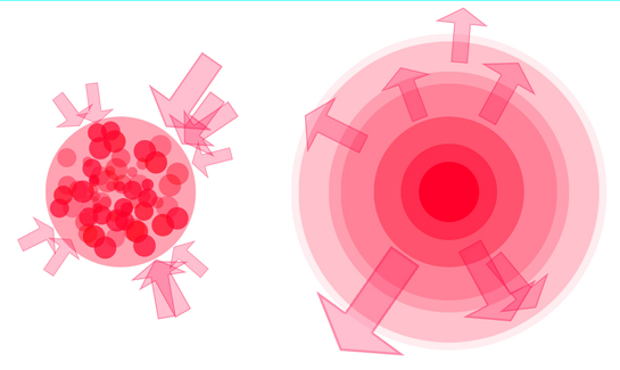
Social networks reinforce a new type of control: a decentralized control operated by a diversity of independent individuals that collaborate, using shared and mobile capacities of calculation and communication. Information and Communication Technologies do not present a solution, but an opportunity to improve our ability to manage territories. ICT’s can be used for many different purposes. On the one hand their enormous capacity for processing data can be used to centralize all the information and try to “solve” urban complexity; but they can also be used to open and decentralize decision-making.
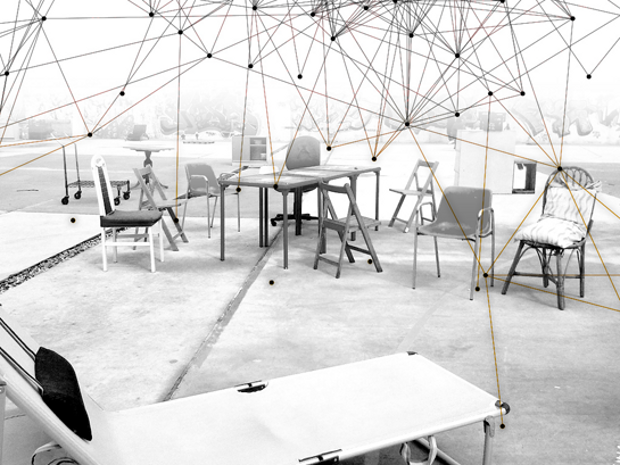
The aim is to research on how ICT’s allow us to define an urban administration structure where discontinued points of control exist in an environment of self-determination (appropriation) and liberty. This is an idea that is close to the definition of tensegrity that Buckminster Fuller mentions: “islands in compression inside a tense ocean“.
The introduction of digital technologies within the physical space enables the development of new communication dynamics and relations between neighbours that improves the cohesion of local communities and their quality of life, offering a feeling of greater security.
Thanks to new technologies and to some cultural “mutations”, systems and worlds that were previously closed and not very transparent, are now open to the participation of agents (and people) who are external to their organisational structures. Citizens become more available to participate and collaborate because they are better informed and they are finally considered as useful partners for the urban administration. Architects and urban planners can reasonably begin to work keeping in touch constantly with citizens, “sharing” their decision-making “powers”.
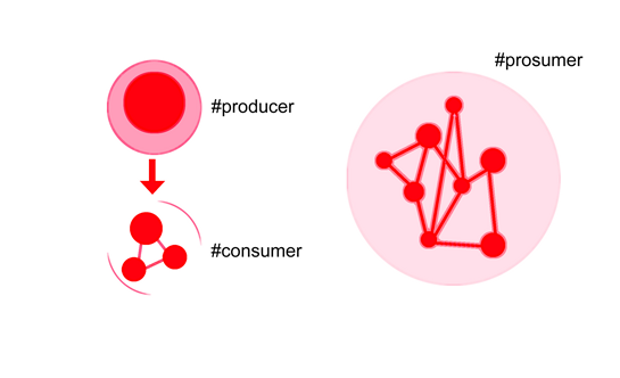
To explain this phenomenon we can refer to the concept of “long tail” coined by Cris Anderson. The Internet and the digital environment have changed the (power) distribution laws and the market rules. The present political and economic system is based on a pyramid structure where the power (or the economic or creative potential) of many is considered inferior to the power of those that stand on the highest part of the pyramid. There is a new system based on the addition or accumulation of all the small potentials (or powers) of the mass of citizens that, thanks to the systems of communication on the internet, can equal or exceed the power (or potential) of those who are in a privileged position today. These are the old markets of masses and the new niche of markets that are pictured at the top and the bottom of the well known graph of statistical distribution.
The presence of a centralized identity is not needed when the control and feedback devices allow the actors to visualize or to become aware of the consequence of their actions. The unconscious self-organisation phenomenon becomes conscious and intended control when the individuals are allowed to understand the effects of their actions. The concept of tensegrity comes in here when it refers to an administration model where decentralized and centralized decisions are joined, avoiding the appearance of any closed and omnipresent control dynamics.
Reversing the supremacy of centralization over individual decisions, citizens can become aware of their actions and intentionally coordinate them. This process may help to restore the necessary legitimacy and credibility to the interventions that take place in degraded urban areas.
Towards participation: Accountability and open data
“Participation demands an information system, an observatory and indicators that will regularly reflect the situation of what we consider as key variables to establish our evolution, that should be accessible and comprehensible for citizens” (Agustín Hernández Aja, 2002)
In 2002, Hernández Aja, Urban planning professor at the Universidad Politécnica in Madrid, describes the essential assumptions for citizen participation. A decade later, communication models and administration dynamics that bring us close to these assumptions start to become popular.
I would like to highlight (point out) accountability and the Open Data movement.
Approaching the term accountability we can create an ecosystem of communication and transparency that can enable citizens to demand responsibilities from governing bodies. This would help us to reach the objective of decentralizing control, which is necessary for a true democracy.
Open Parlamento (openparlamento.it) is a great example of how to work to achieve accountability. It is a web-based tool that enables distributed monitoring of the work of the members of parliament in the Italian parliament.
The web page offers lots of information on draft legislation, and in general, about all the activities in the Parliament. Most interesting of all is the distributed monitoring system that allows for control of every Member of Parliament’s political activities. Every citizen can “adopt” a member and publish all their declarations and confront them with their parliamentary activity.
We can imagine this same system applied on a local scale, where citizens have greater organization capacities and power to exert pressure. The control to which all the local administrators would be subject to, would be so intense that they would nearly be obliged to start up a transformation of the administrative structures towards a more open and participatory model.
The Open Data movement is an important drive towards achieving transparency over public administration. Open Data consists of making Public Administration data available for the public, such as data related to projects that are financed with public money or managed by public institutions.
The aim is to take advantage of the data that the public administrations do not want or do not have the capacity to analyze. Releasing this data enables any person or organization to build new consultation and visualization formulas, to simplify, diversify and even to enrich the initial information.
In Spain, within this new tendency, the Open Data Euskadi project should be highlighted. It is part of the Open Government initiative of the Bask Government: a website dedicated to the exhibition of public data in a re-usable format, under open licenses. On an urban scale, two projects stand out that have been activated by two Spanish cities; Zaragoza and Córdoba. They are beginning to take their first steps in the world of Open Data.
I am convinced that citizen pressure will force all the big cities to join this process of openness and transparency.
As we mentioned previously, reversing the supremacy of centralization over individual actions, citizens can become aware of their “power” and begin to organize in networks.
We have the technology the knowledge and the dynamics available to introduce more open urban administration processes. Citizens have begun to move; the administrations could take advantage of these autonomous and independent processes, to manage very complex situations. However, a clear political will is still lacking.
Probably the administrators have managed to delay the transition towards a new participatory administration model, thanks to the indirect or even direct support of what is known as the “fourth power”: the media. The current information system still offers the administrators and the “powerful” a wide opportunity to manipulate and control certain processes.
The emergence of a more distributed information model is beginning to offer to any citizen the possibility to produce relevant local information. A communication ecosystem based on social media is born.
This new information ecosystem can reduce the influence of the mass media and therefore force the local administrators to enforce accountability regarding the decisions that are taken. The administrators will be compelled to relate to this new, more horizontal and distributed form of communication: an opportunity to generate “social control” that can improve transparency and force the local administrators to take the public opinion into account.
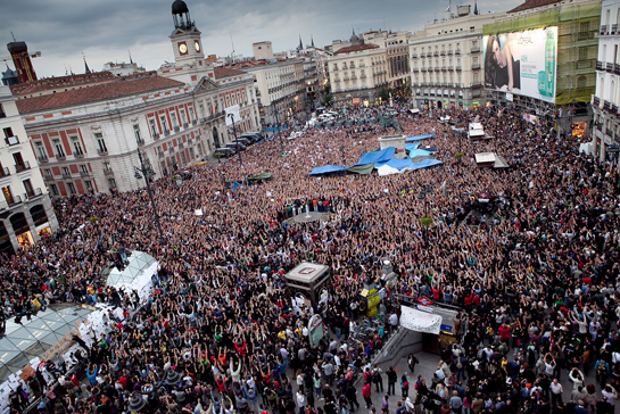
A clear example of what is being presented here, are the latest citizen mobilizations that are happening in Spain. After the 15M demonstration, an organized and authorized event, many occupations took place in numerous squares in the whole of Spain. These camps were organized in a matter of hours using Twitter and Facebook. It is impossible to exert control over these information flows and action catalysts like the occupations. Steps have been taken towards a model in which governors and administrators are going to have to understand that they cannot continue to ignore the citizens while they defend the interests of others.
We are witnessing an innovative construction process of a new communal and public sphere; the development of a new model of public space that we have called “sensitive space”. Traditional media don’t communicate what we the people are debating on a daily basis, nonetheless, thanks to Social Networks, people can receive information and interact in real time with others taking part in debates and social movements, the example of the occupation of public squares is an example of this.
It is interesting to note that the in-situ (on-site) realm is absolutely essential and how the digital media is simply offering a wider environment for communication so that the organisation of any given action is greatly improved; everything becomes decentralized while at the same time connected and synchronized.
These processes seem to be nearly inevitable. Once they are established as natural local administration processes then we will be speaking about a more favorable environment, for an Open Source City, that is, a city open to everyone’s participation.
picture of the roofgarden at Blågård School by DYRK Nørrebro
DYRK Nørrebro | an urban agricultural initiative in Copenhagen, Denmark
Urban agriculture, or agriculture in the city, is an ‘umbrella term’ that covers activities related to production of food in or on the outskirts of cities. A definition used by UN, UN-Habitat, FAO and other important international research institutions explains it as following: continue reading
After few months of intensive work at Ecosistema Urbano, we are pleased to announce the launch of dreamhamar, a network design process around Stortorget square in Hamar, Norway.
Network Design is a process of open and transparent design allowing both local and international contributors to work and propose solutions for the same project. For more information about dreamhamar and network design process you can visit the ABOUT page.
Since one of the main purposes of dreamhamar is to encourage people’s participation in the project, please don’t hesitate to share with us your opinions and ideas by commenting this post or just through the CONTACT page.
One of the tools we will be using to communicate the progress of the project is the HAMAR EXPERIENCE, a weekly video broadcasting in which the Local Lab Team and Ecosistema Urbano will describe the project in progress. We will share reports about activities, challenges encountered during the process along with the every day life of the Local Lab Team. HAMAR EXPERIENCE aims to make the process a shared and learning architecture experience.
CONFLICT, el décimo número de la publicación trimestral , ya está disponible. Los colaboradores de este número son Jonathan Andrew, Christopher Baker, Vladimir Belogolovsky, David Garcia Studio, dpr-barcelona (@dpr_barcelona), Peter Eisenman, Thomas Hillier, Alex Lehnerer, Nora Niasari, OMNIBUS, Mika Savela, Simon Scheithauer, Cameron Sinclair y Urban-Think Tank.
La revista acaba de estrenar un nuevo diseño web para facilitar el acceso a todos los artículos publicados en estos diez números (más de 100) y permitir comentarios para continuar la conversación. Podéis ver todo el contenido en www.mascontext.com.
Any analysis of today’s reality of European or Spanish cities and their current urban trends will entail placing them in a context of crisis that globally implies, among other structural issues to be taken into account: climate change –with unforeseeable characteristics and demanding modifications to be made to energy and consumption models- or the enormous concerns for the collapse of world economy and the crisis of financial systems and their direct or indirect impact on urban ways of life. This very complex moment forces us to be more conscious of our limits and announces the end of an era of apparent safety and the beginning of another that ranges between the unforeseen and the uncertain.
The current crisis is particularly serious in Spain due to the economic model of preceding years, strongly based on building construction and exploitation of resources, in particular the resource of land. In this context of required change it is necessary to try to focus on a fixed reference point or frame where the basic axis for urban interventions can be set. The current scenario is a complex one, there are few certainties and time and processes are key characters. However, this crisis, like any other crisis, is not only useful for correcting trends but mainly for detecting opportunities. A time of large changes and few certainties is probably when the greatest demand for creativity, innovation and prospecting for opportunities for the future should occur, as well as when time should be taken for thinking before acting, making the most of a moment of lesser economic acceleration. continue reading
The main idea is to develop a digital “no city guide” for the pleasure of the “flâneur urbain”. The review is edited in French language, but English and Spanish Papers are allowed, so most authors will be able to write in their mother tongue. You can find more details (in French) on our web pagecontinue reading
These 11 blogs will help you keep on top of news and views about various aspects of urbanism and city life in 2011.
Planetizen.com: An urban planning news website, featuring articles, op-eds, jobs, courses and information for the urban planning, design and development. (@Planetizen)
PriceTags: Gordon Price is a former Vancouver city councillor and the Director of the City Program at Simon Fraser University. His blog gives readers an insider’s perspective of urban issues. While it with a focus on Vancouver, he cover topics of interest to anybody interested in urbanism.
Urbanophile:Aaron M. Renn’s blog focusing on helping America’s cities thrive and find success in the 21st century. He offers unique perspectives and innovative strategies for cities and their residents. (@Urbanophile). continue reading
Detroit is known by many as the birthplace of techno, a reputation that has preceded the shrinking city among music-savvy youth for 20+ years. Like most twenty-something Americans, I have never really considered visiting the city of Detroit – that’s why, when i was asked “what Detroit is like” while living in the other techno-capital, Berlin, I didn’t have much of anything to say – except for something along the lines of “i hear it’s pretty cold”. continue reading
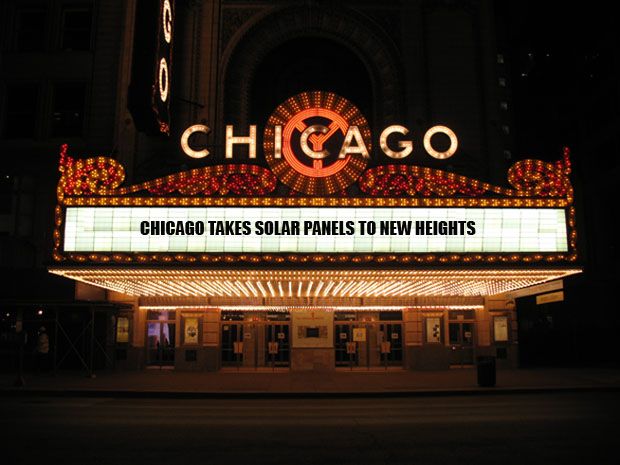
When people get to talking about the greenest city in the U.S., they’re usually referring to Portland, Oregon, which boasts an exceptionally, historically environmentally conscious, pro-active citizenship. Chicago, with its famous theater, symphony, and Navy Pier bi-weekly summer firework displays, is usually acknowledged for its art and music.
This week though, we’ve learned that Chicago is taking its environmentally friendly architectural history one step further. The Willis Tower, formally known as the sears center, will be adding a vertical solar farm on the 56th floor.
The Willis tower is tall – really tall. In fact this ¨planting¨ means there will soon be a vertical solar farm on the tallest building in America!
While Chicago is definitely not the most environmentally conscious city in America, as it lacks the extent of aggressive sustainable development policies and pro-active citizen initiatives that Portland owns, Chicago’s leadership in promoting ¨green¨ architecture is really something special.
Chicago is the city of the arts – it’s a visual city. Adorning the tallest building in the country with solar panels represents and promotes sustainable development as a partner of the American city.
The 1.3 million tourists who come to gape at the willis building each year will now have a bit greener of an image of what 21st century urbanism can be. I propose the addition of a vertical garden next…