Comments: (0)

ecosistema urbano at Master Class ‘The public space along the channel. The water and the city’ | Brussels 5-7 June

Category: ⚐ EN+ecosistema urbano+events+urbanism

Masterclass at Pyblik

This week I will take part as an international expert at the Master Class ‘The public space along the channel. The water and the city’.

The master Class is organized by ]pyblik[ (www.pyblik.be), an initiative of the Brussels Capital Region in collaboration with 2 schools of architecture in Brussels,  LUCA School of Arts- Department of Architecture and the Faculty of Architecture of the University of ULB. Its aim is to centralize the knowhow and expertise in public spaces.

As part of the course, masterclasses are organized for professionals, designers and project managers, who will reflect together on a specific case. During the 3day masterclasses the focus will be the public space around the canal district in Brussels. I will be joining local experts Dirk van Peijpe, Guy Vanbeeck and Thierry Kandjee for a discussion.

Within this framework, I will offer a lecture presenting the most recent woks of ecosistema urbano. The lecture will take place on Wednesday June the 5th at 8 pm at the Faculty of Architecture Luca-arts in Brussels.

For more info in NL/FR.

Comments: (0)

International summer course (update) | Urban design and sustainable architecture

Category: ⚐ EN+architecture+sustainability+urbanism

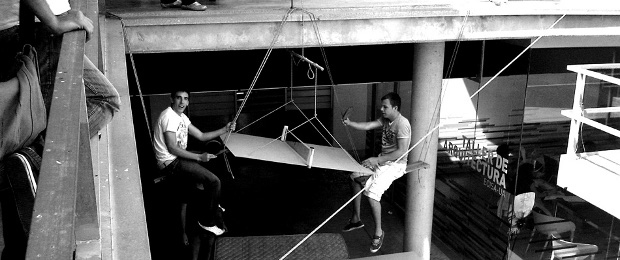
Architecture in Alicante

The international summer course in Alicante we presented a couple of months ago is finally going to happen!

So far, 14 international – from quite diverse places like the US, Ucrania, Lebanon or South Corea – and 8 local students have already registered, and the University of Alicante just extended the registration period over June, so you still have a chance to join!

More Than Green international summer course

Sustainability is not just an environmental issue but, and above all, a social, cultural and economic one. This course about URBAN DESIGN and SUSTAINABLE ARCHITECTURE proposes a complex incursion within the subject of sustainability understood not only as a problem but as an opportunity to meet new approaches to the city in a creative, innovative, playful and unprejudiced way.

Sustainability in an international environment: Experts in sustainability, teaching and design from all around the world meet in Alicante.
Learning by the sea: Meet friends from all around the world and enjoy the Mediterranean culture, a different way of understanding architecture, the city and life.
Challenging yourself: A fresh and playful approach to sustainable design.
Finding your way: We offer a wide variety of thematic contents as well as plenty of activities for your free time.

Faculty

We will be taking part with PLAYstudio – the organizers –, Transsolar and Urban Think Tank. Looking forward to meet you there!

Place and date: University of Alicante, Alicante, Spain. 15-26th July 2013
Learn more: International summer course (by the sea)Versión en español
Official website: summercourse.morethangreen.es

Comments: (0)

Jose Luis Vallejo at TU Graz | Institute for Architecture and Landscape

Category: ⚐ EN+events+news+urban social design+urbanism

Jose Luis Vallejo

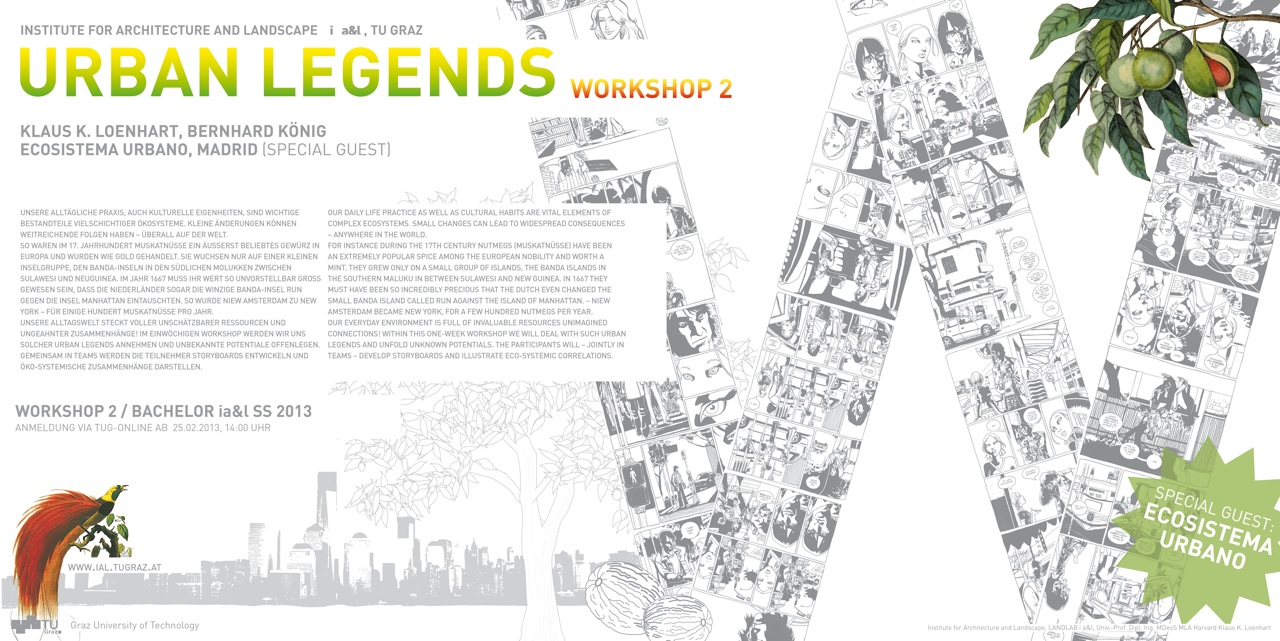
Jose Luis Vallejo will be giving a lecture next week at the ia&l (Institut für Architectur und Landschaft) from the Graz University of Technology. He will also take part in the “Urban Legends” workshop as a guest:

Urban Legends Workshop

More info:

ia&l website: ial.tugraz.at
A recording of the lecture will be available at e-presence server TU Graz

Comments: (2)

International summer course (by the sea) | Urban design and sustainable architecture

Category: ⚐ EN+architecture+sustainability+urbanism

More Than Green international summer course

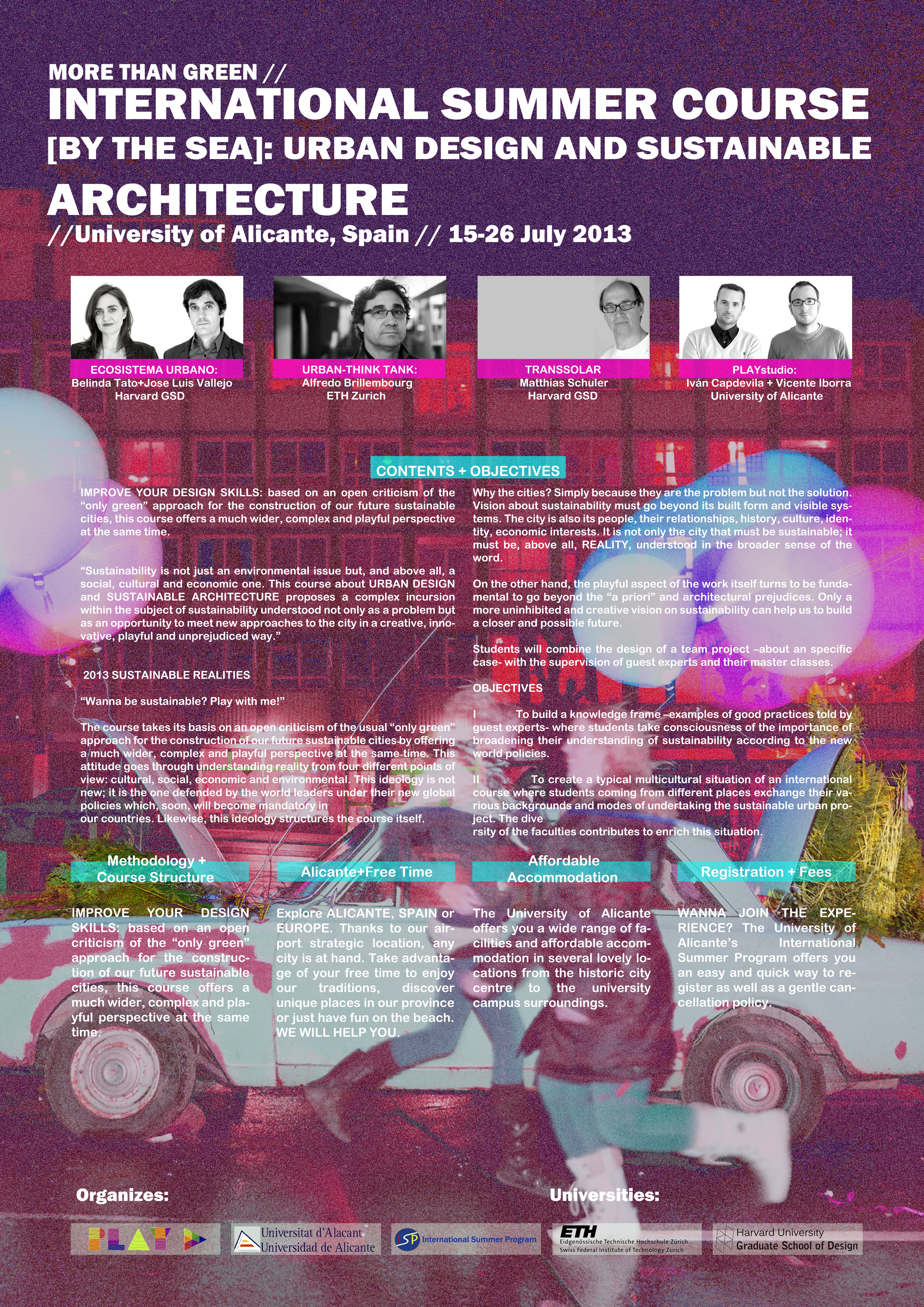
The people behind More Than Green have organized a great summer course on July 15-26, 2013 in the mediterranean city of Alicante (Spain), where we will also be taking part together with PLAYstudio, Transsolar and Urban Think Tank.

Sustainability is not just an environmental issue but, and above all, a social, cultural and economic one. This course about URBAN DESIGN and SUSTAINABLE ARCHITECTURE proposes a complex incursion within the subject of sustainability understood not only as a problem but as an opportunity to meet new approaches to the city in a creative, innovative, playful and unprejudiced way.

More Than Green

Contents + Objectives

Architecture in Alicante

Improve your design skills: based on an open criticism of the “only green” approach for the construction of our future sustainable cities, this course offers a much wider, complex and playful perspective at the same time. Students will combine the design of a team project –about an specific case‐ with the supervision of guest experts and their master classes.

Build a knowledge frame –examples of good practices told by guest experts‐ where students take consciousness of the importance of broadening their understanding of sustainability according to the new world policies.

Create a typical multicultural situation of an international course where students coming from different places exchange their various backgrounds and modes of undertaking the sustainable urban project. The diversity of the faculties contributes to enrich this situation.

Methodology + Course Structure

Architecture in Alicante

Master classes, teamwork and project reviews within the context of four different ways of understanding sustainability: ENVIRONMENTALLY, SOCIALLY, ECONOMICALLY and CULTURALLY.

Faculty

Faculty

DIRECTOR: José Luis Oliver Ramírez  (University of Alicante) + TRANSSOLAR: Matthias Schuler (Harvard GSD) + URBAN-THINK TANK: Alfredo Brillembourg (ETH Zurich) + ECOSISTEMA URBANO: Belinda Tato y Jose Luis Vallejo (Harvard GSD) + PLAYstudio: Iván Capdevila y Vicente Iborra (University of Alicante)

Alicante + Free time

Lively Alicante at dusk

It’s summer, you’re by the coast… who would dare to keep you away from having fun?  Within the course structure, it is programmed a considerable amount of free time so the students can visit other cities or some interesting spots on the surroundings, enjoy the sun and the beach, or take part in different summer activities organized by the University of Alicante.

Acommodation

University of Alicante

The University of Alicante offers you a wide range of facilities and affordable accommodation in several lovely locations from the historic city centre to the university campus surroundings.

You can download the brochure here: MTG International Summer Course  – PDF
For a more information on fees, acommodation, organization, etc. check the official website: summercourse.morethangreen.es

Comments: (0)

Resolution planning and design for peace

Category: ⚐ EN+city+findings+urbanism

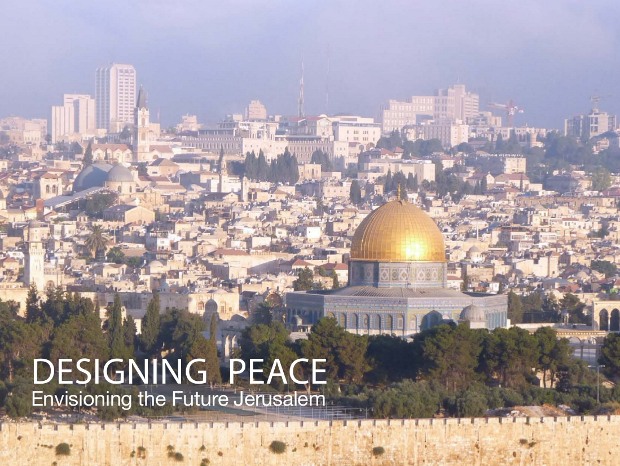
Is Peace a matter of design? Do designers have a role in it? During our stay at Harvard GSD last Fall semester, we had the pleasure to meet architect Karen Lee Bar-Sinai who is a current Loeb Fellow there. Last January she launched the workshop DESIGNING PEACE, looking into how designers can envision peace for the city of Jerusalem. Below is a description of the course and the links to some of the contents and results. We hope you find them inspiring.

designing peace

Architecture and Planning may seem to be of little relevance to Conflict Resolution. However, territorial conflicts occur in space, and so are their solutions. It is time architects, planners and policy makers approach disputed territories together to plan viable, peaceful futures for disputed areas.

This workshop invites you to join an exploration of how design can aid envisioning peace in conflicted territories. We will explore the possible meaning of Resolution Planning – originally a concept and practice developed by “SAYA/Design for Change” (sayarch.com) . Together we will try to give broaden this term, and find new ways to encourage policy makers to think as architects, and to encourage architects to think as policy makers.

Palestinian and Israeli zones on Jerusalem

The 5 day solution-oriented workshop will focus on Jerusalem as a case study for other contested cities such as Belfast and Nicosia. We will plan, think and design at various scales, and propose innovative ideas for peace. Several sites will serve as case studies (one will encourage a landscape intervention, another an urban design strategy, and a third will call for a more general policy oriented vision for the future Jerusalem seam-line). The workshop is planned to be followed by a publication.

Goals and Outcome:
The goal of the workshop is to develop spatial-based concepts to aid peace. We also plan to gather the various proposals into a publication which will include both the theoretical framework and examples of various tools for planning peace.
Above all, we wish for this effort to truly aid overcoming the stalemate in the peace process, which we believe it is crucial to future of both Israeli and Palestinian. We therefore wish this event to be as interesting, meaningful and involving as possible, in order for its fruits and visions of peacemaking to be of highest impact.

Among the contents and results of the workshop we highlight here an introduction to resolution planning and a lecture by Karen on the topic:

More info:

Results: Gallery of the workshop | Same in slideshow mode
Homepage: designing-peace.com
Related website: ispeacepossible.com

Comments: (3)

Hybrid Cities and Networked Participatory Design Systems | Hybrid Space Lab

Category: ⚐ EN+architecture+open culture+urban social design+urbanism

Coinciding with the rise of digital tools that foster participatory systems, Hybrid Space Lab is an entity that exists in the realm between architect and client, the traditional shapers of space. In this article, originally published here, Elizabeth Sikiaridi and Frans Vogelaar of Hybrid Space Lab share three of their projects and their thoughts on networked participatory design systems today.
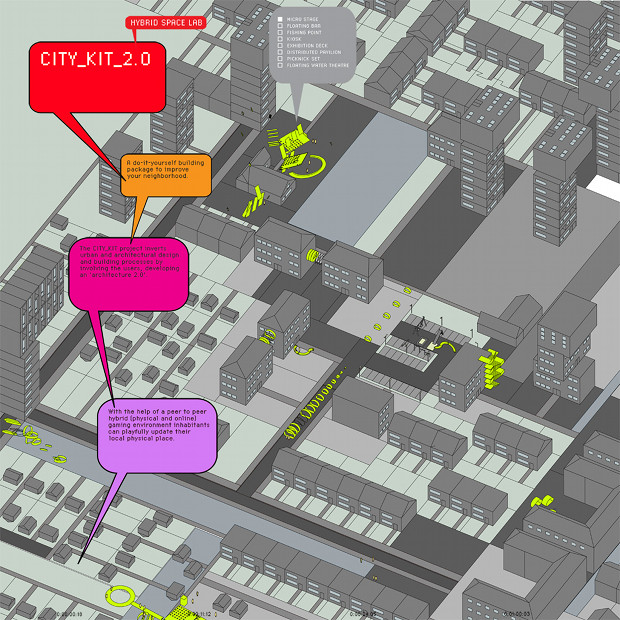
The CITY KIT hybrid game by Hybrid Space Lab

The CITY KIT hybrid game by Hybrid Space Lab

CITY KIT

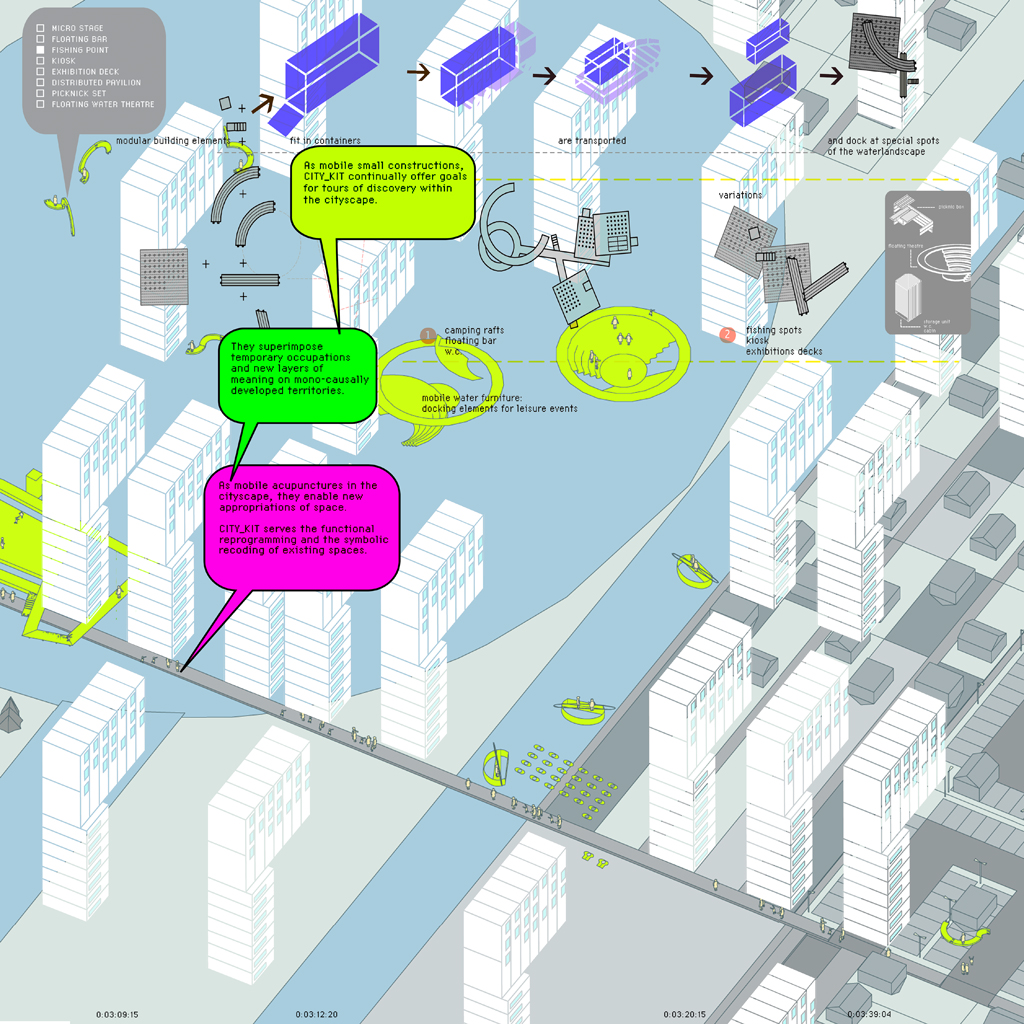
CITY KIT is a combined urban-computer game to upgrade your neighborhood. The CITY KIT project was developed for the Hong Kong Social Housing Authority with as a target group young people that are familiar with computer games but hardly play outside.

This hybrid game revolves around city planning and urban redevelopment. CITY KIT turns the residents into the “makers” of the city, providing thus a bridge between the users of the urban environment and the experts – the architects and the urban planners.
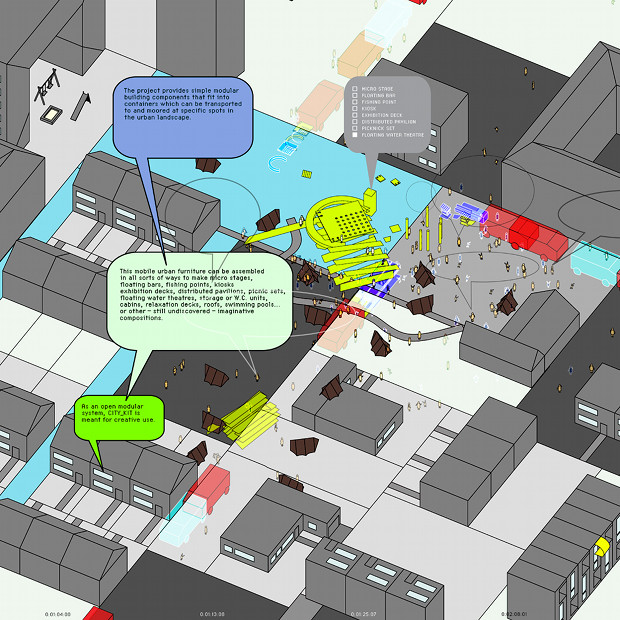
The CITY KIT hybrid game by Hybrid Space Lab

The CITY KIT hybrid game by Hybrid Space Lab

Playing the CITY KIT game, the residents can adapt and improve their local physical environment by building a digital version of their neighborhood. Using modular building components that can be moved around and fixed in certain places in the environment, users can build micro-stages, exhibition decks, floating bars and theatres, swimming pools and other recreational facilities that make living in the neighborhood more fun.

The CITY KIT hybrid game by Hybrid Space Lab

The CITY KIT hybrid game by Hybrid Space Lab

CITY_KIT is an open-source medium in which participants can add elements and share their designs. An online platform in the form of a website allows residents to actively take part in the game. All it takes is a simple click of the mouse to interactively test your own virtual version of CITY KIT.

Residents and game users can design their own objects and facilities and can realize their ideas: A ‘real’ object, an analog version of the proposed CITY KIT element, can be built at the chosen location.

On the website, the user can also pinpoint exactly where a digital object should be located in the analogue world. This can be done using a mobile phone.

The CITY KIT hybrid game by Hybrid Space Lab

The CITY KIT hybrid game by Hybrid Space Lab

The goal of CITY KIT is to help you revalue your local surroundings and incorporate the new, imaginative layers created in CITY KIT’s virtual world. Making small modifications to the personal, physical environment in digital space changes the experience of living in the real world.

DIY Pavilion by Hybrid Space Lab at the Hong Kong & Shenzhen Bi-city Biennial of Urbanism and Architecture 2009-2010 Photo by Andy Tam

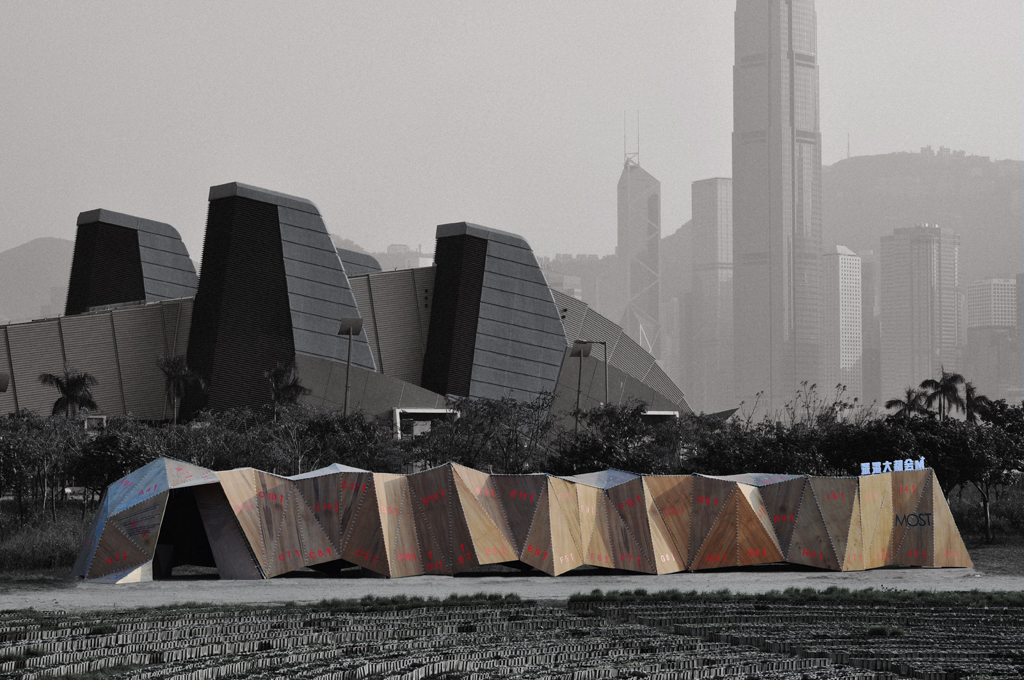
DIY Pavilion at the Hong Kong & Shenzhen Bi-city Biennial of Urbanism and Architecture 2009-2010. Photo by Andy Tam

DIY Pavilion

Outcome of the CITY KIT project was the DIY Pavilion, first presented at the waterfront promenade of Hong Kong within the framework of the Hong Kong & Shenzhen Bi-city Biennial of Urbanism and Architecture 2009-2010 and later set up at the Hong Kong Jockey Club Creative Arts Centre and at the Kwai Tsing Theatre in Hong Kong.
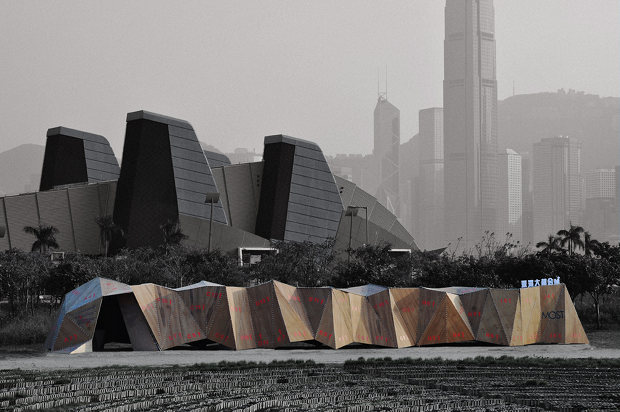
DIY Pavilion by Hybrid Space Lab at the Hong Kong & Shenzhen Bi-city Biennial of Urbanism and Architecture 2009-2010; photo by Andy Tam

DIY Pavilion at the Hong Kong & Shenzhen Bi-city Biennial of Urbanism and Architecture 2009-2010. Photo by Andy Tam

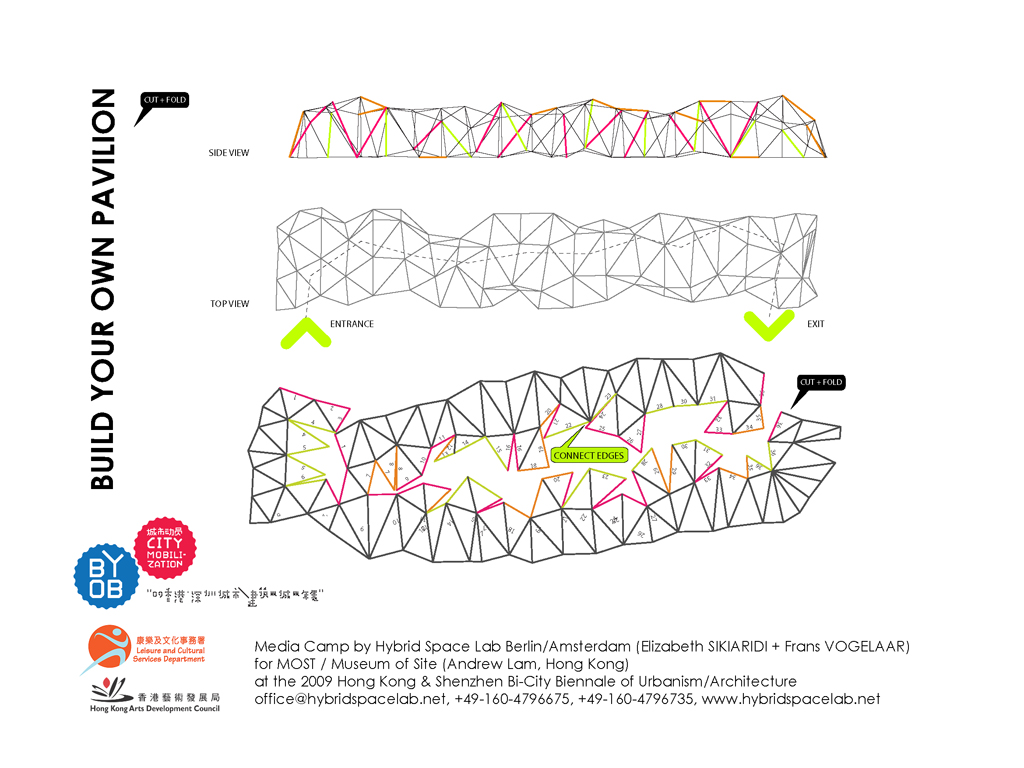
Following the CITY KIT concept, users can co-create their design of the pavilion. The pavilion’s architecture is based on an architectural design principle with a flexible structure that can adapt to site and program requirements, to different content, context and spatial situations. The structure of the pavilion architectural design principle makes it possible to involve the users in the design, building and transformation of the pavilion.
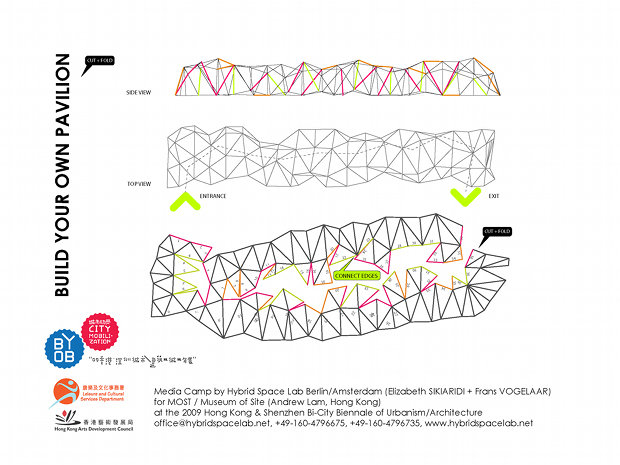
‘Build Your Own Pavilion’ at the Hong Kong & Shenzhen Bi-city Biennial of Urbanism and Architecture 2009-2010

‘Build Your Own Pavilion’ at the Hong Kong & Shenzhen Bi-city Biennial of Urbanism and Architecture 2009-2010

The pavilion consists of triangular plywood plates sown together with the help of cable binders. It is a flexible mobile structure to be easily disassembled, transported, reassembled and sown together again, adjusting to the size of the site and the local requirements.

Detail of the DIY Pavilion by Hybrid Space Lab; photo by Andy Tam

Detail of the DIY Pavilion by Hybrid Space Lab; photo by Andy Tam

Videos on urban issues were projected on the triangular crystalline structure of the pavilion’s interior as the pavilion travelled to the different locations for community education.

Model of the DIY Pavilion by Hybrid Space Lab. Photo by Julian Roeder

Model of the DIY Pavilion by Hybrid Space Lab. Photo by Julian Roeder

Model of the DIY Pavilion by Hybrid Space Lab. Photo by Julian Roeder

SIMPLE CITY

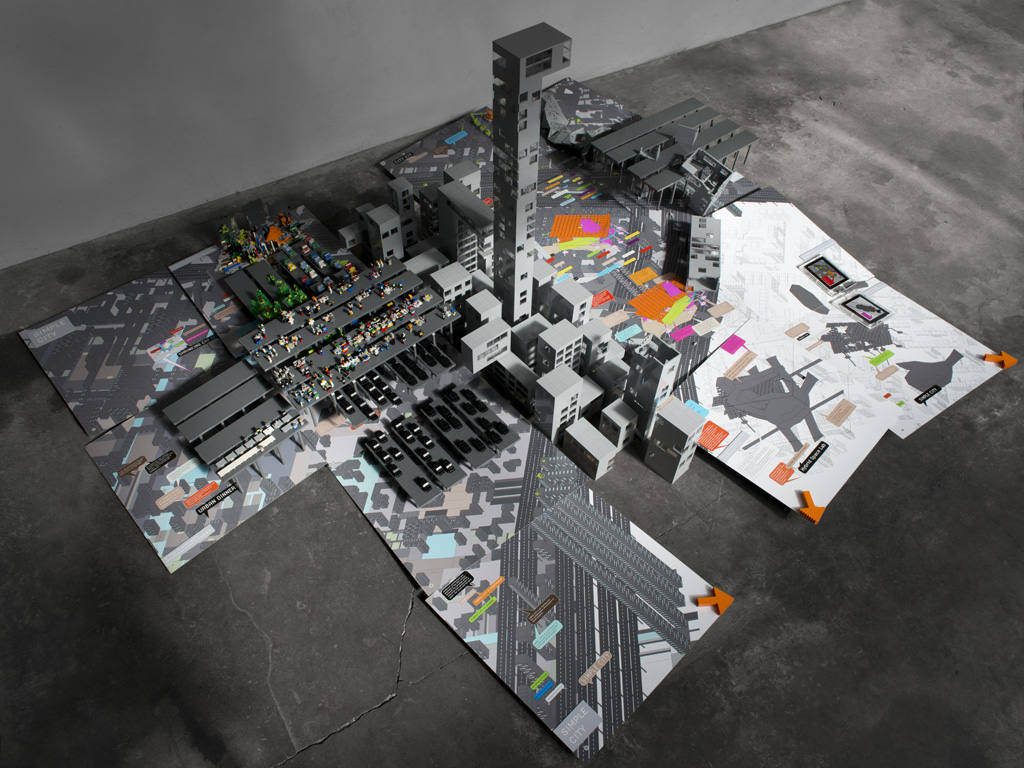
Both projects, CITY KIT as well as the DIY Pavilion, were recently presented within the framework of the SIMPLE CITY installation by Hybrid Space Lab at the MAKK Museum of Applied Arts Cologne from May to August 2012 and at the first issue of plan – Architecture Biennial Cologne (plan – Architektur Biennale Köln in German) in September 2012.

The SIMPLE CITY is an interface for the participative development of urban projects by professionals and laymen. The design of this simulated urban environment can be broken down to simple elements that can be copied and modified by the users of the city.

SIMPLE CITY installation by Hybrid Space Lab at the MAKK Museum of Applied Arts Cologne from May to August 2012. Photo by Hybrid Space Lab

SIMPLE CITY installation by Hybrid Space Lab at the MAKK Museum of Applied Arts Cologne from May to August 2012. Photo by Hybrid Space Lab

Laymen and city-users by copying, pasting and modifying the basic elements can easily adapt the urban design in order to develop new urban settings.

With its modular setting SIMPLE CITY corresponds to the serially produced, global, generic city (with all the instabilities and breaks). SIMPLE CITY therefore refers to the city of the industrial age that was intrinsically related with the system of serial industrial mass production. The city of the industrial age was serially produced as the addition of generic urban elements. Therefore the model elements of the SIMPLE CITY installation were built with the help of modular building bricks that were sponsored by the Danish company Lego.
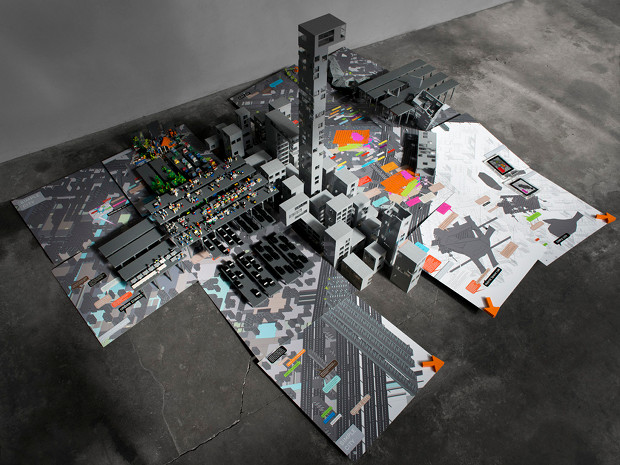
SIMPLE CITY installation by Hybrid Space Lab at the plan - Architecture Biennial Cologne, September 2012. Photo by Hybrid Space Lab

SIMPLE CITY installation by Hybrid Space Lab at the plan. Architecture Biennial Cologne, Sept. 2012. Photo by Hybrid Space Lab

SIMPLE CITY is an interface that enables the communication of dynamic and networked information on urban projects. It forms an environment for interactive collaboration and for communication of process-oriented urban and architectural projects. This includes projects on the energy and material cycles of the city, on urban conversion and on networked participatory urban and architectural design, such as the CITY KIT and the DIY Pavilion projects.

Networked Participatory Design Systems Today

The projects described above stand in the long tradition of participatory urban design, in the long tradition of the efforts of inserting the voice of the public into the process of shaping cities. Today these networked participatory design projects, such as CITY KIT, DIY Pavilion and SIMPLE CITY, are part of a general trend and of a paradigm shift.

Networked organizations and systems are today transforming our society in general. With new technologies and digital media currently transforming production and social communication, urban and architectural design is being redefined in a new context.

Participatory urban and architectural design systems are gaining –in the context of a networked society– in relevance. This is a general phenomenon as networked co-operation and open-source are to be found in many contemporary social and cultural expressions.

Current social-political are using social media tools and mobile media networks. Fluctuating networked political forces distrust established political parties and contest the concept of the ‘political expert’, creating independent self-publication channels and demanding ‘direct democracy’.

Networked systems are also transforming knowledge production; think of the Wikipedia, ‘the free encyclopedia that anyone can edit’. Co-operation, co-authorship and open-source are to be found in many contemporary cultural expressions and phenomena, such as, for example, Wikimedia Commons, the free media file repository making available public domain and freely licensed educational media content (images, sound and video clips) to everyone.

Users, aided by improvements in information-communication technology are increasingly developing their own new products and services, ‘democratising’ innovation. These innovating users often freely share their innovations with others, creating user-innovation communities and a rich intellectual commons.

The word “prosumer” is used in this context to describe the type of consumer who becomes involved in the design and manufacturing of products, so they can be made to his individual specification. The word “prosumer” blends the roles of producer and consumer and was first coined in 1980 by the futurist Alvin Toffler in his book “The Third Wave”.

Today the “prosumer” can be engaged in innovation and design as well as in the manufacturing of products that fit his individual specifications and needs. In the last years 3D printing has developed to a low cost technology that everyone can use to produce objects. 3D printing allows industrial production on a desktop scale enabling autonomous production for individuals and designers. This development of object production is enabled by the Internet and by the acceleration of technological developments and open source communities. The digital blue prints of objects are designed in 3D software and can be shared via digital networks. On special Internet platforms people share these open source 3D designs that can be produced via rapid prototyping with 3D printers.

Networked participatory design systems are replacing the logics of the industrial age, where the creative one designed for the non-creative masses. The architects and urban designers focus is shifting from designing objects and spaces to programming processes in interaction with users. The task of ‘designing’ processes for networks of people involved on the development of the urban environment is gaining in relevance. This means a shift from centralized to (distributed) participatory systems with ‘enabling solutions’ that involve users. This includes solutions and platforms that ‘enable’ users to interact, integrating users as participants into development processes of the urban environment – such as the CITY KIT, SIMPLE CITY and the DIY Pavilion.

Originally published at world-architects.com

Elizabeth Sikiaridi and Frans Vogelaar founded Hybrid Space Lab, a R&D and design practice focusing on the hybrid fields that are emerging through the combination and fusion of environments, objects and services in the information-communication age. The scope of our development and design projects ranges from those on urban games and planning to buildings, architectural interiors and industrial design applications and wearables.

Hybrid Space Lab is an interdisciplinary environment with an innovative and integrated approach to spatial issues. The focus of our work lies in fusing digital and analog environments, in embedding media networks in urban/architectural, social and cultural spaces. Hybrid Space Lab is a lab and a network in which architects, urbanists, landscape architects and environmental planners, designers, soft- and hardware engineers collaborate in the development of projects for combined analog and digital, urban, architectural, design and media spaces.

Hybrid Space Lab recently developed visions for the program of the new institute that will be formed by the merger of the Netherlands Architecture Institute (Nederlands Architectuurinstituut), the Netherlands Institute for Design and Fashion (Premsela) and the institute responsible for digital culture (Virtueel Platform). For an English text see here.

Comments: (0)

Importing Architecture | Photos from the exhibition in Oslo

Category: ⚐ EN+architecture+ecosistema urbano+events+urbanism

Arkitektur Import - entrance

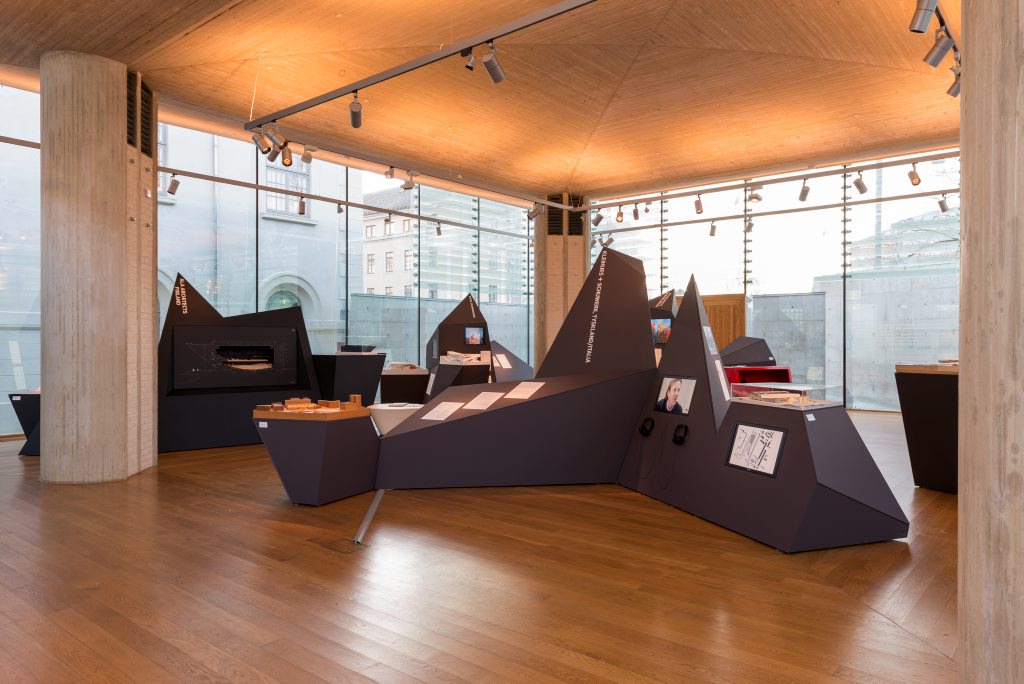
Today we are sharing with you some pictures of the impressive exhibition Importing Architecture which is on right now at the Nasjonalmuseet (National Museum for Art and Architecture) in Oslo.

We had the pleasure to be included in the selection and it was a great opportunity to attend the opening last November and get a chance to know more about the different projects which are under construction or have been just finished as well as the international offices who are behind them.

Åpning Arkitekturimport - exhibition opening

Åpning Arkitekturimport - exhibition opening

The exhibition raises the question of Norwegian identity in architecture and how ‘imported architects’ respond to it:

Are foreign architects reinforcing the trend toward a type of globalization that is dissolving national and cultural differences? Or are they even more concerned with formulating a Nordic or Norwegian identity than their Norwegian counterparts? Is it possible for an architect to create exceptional architecture in Norway without first-hand experience of Norwegian society, building traditions, climate or the natural environment? Or on the contrary, do foreign architects bring new ideas and ways of thinking that enrich the quality of Norwegian architecture?

Arkitektur Import - general view

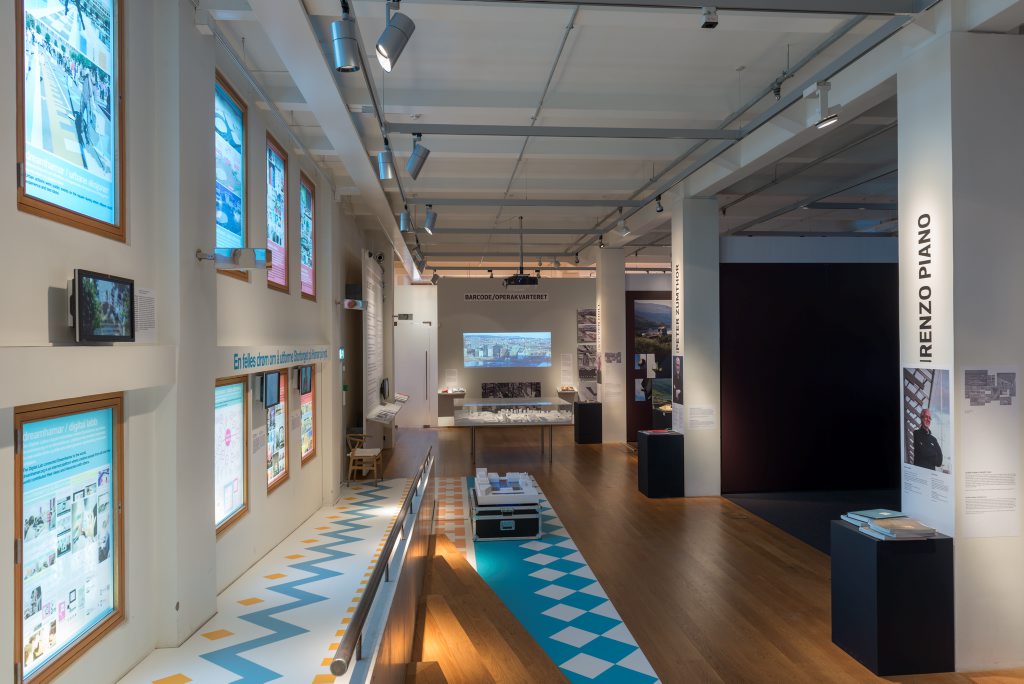
Our installation is located by the ramp at the entrance of the exhibition. We tried to take advantage of the windows to display images of the Dreamhamar project, along with four screens showing videos from the process. The physical-digital scale model of Stortorget (Main Square) was also brought from Hamar and installed on top of a vinyl that covers the floor resembling the pattern painted by Boamistura on the asphalt of the real square.
Arkitektur Import - windows

Arkitektur Import - general view

Arkitektur Import - looking towards the entrance

If you are in Oslo sometime between now and April, don’t miss it!

Photographers: Andreas Harvik and Børre Høstland.
Related post: Importing architecture | Exhibition in Oslo 

Comments: (0)

Low Budget Urbanity: frugal practices transforming the city | Call for papers

Category: #follow+#followresearch+⚐ EN+convocatorias+sustainability+urbanism

The trans-disciplinary research initiative “Low-Budget Urbanity. Frugal Practices Transforming the City” invites PhD and post-doctoral researchers to their first Early Career Laboratory from March 25th to 28th 2013 at HafenCity University in Hamburg.

Low Budget Urbanity - visit website

Low-Budget Urbanity is a research programme that explores contemporary urban phenomena such as ridesharing and online hospitality networks, water-saving infrastructures and DIY-practices of house owners, and second-hand consumer cooperatives as saving practices that transform the urban setting. These self-organized saving practices all involve “complex encounters, connections and mixtures of diverse hybrid networks of humans and animals, objects and information, commodities and waste“ (Sheller and Urry 2006:2).

Public budgets are slashed, many cities are burdened with near-paralysing debt, and for private households, too, saving money often is less a virtue than the order of the day. As a search term of an exploratory and multidisciplinary research project, “low-budget urbanity” provides a relational perspective on those seemingly disparate austerity phenomena. The research focuses on the question of how these phenomena are transforming cities.

What is new is not that saving money constitutes a principle of individual practices (rationalized building, economic or political action, individual budget planning, etc.), but that the austerity imperative for the assemblage, i.e. the confluence and interaction of these principles has become a force that shapes and defines cities.
Next you can find a call for papers that many of you may find interesting, with the topic “What is the value of saving costs? The urban economics and politics of everyday saving practices”.

CfP EarlyCareerLab LBU

More info:

Official website: low-budget-urbanity.de
Research group funding programme

Comments: (0)

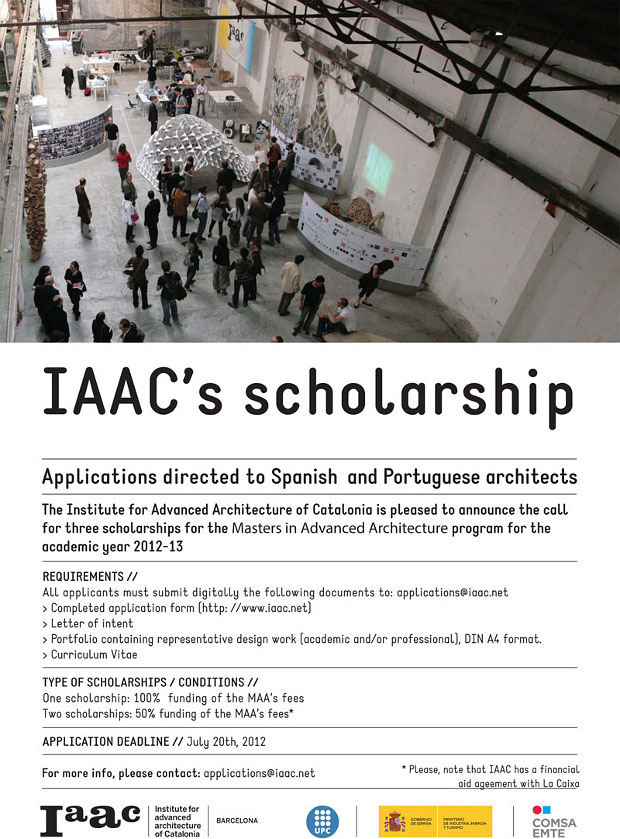
Becas IAAC 2012-2013

Category: ⚐ EN+architecture+creativity+news+technologies+urbanism

IAAC scholarships


More information:

www.iaac.net
www.iaacblog.com
www.fablabbcn.org

Comments: (4)

Ecosistema Urbano prequalifies for a planning competition in Kiruna, Sweden

Category: ⚐ EN+competitions+ecosistema urbano+news+urbanism

Ecosistema Urbano has, together with the Norwegian architecture office 70°N arkitektur, the Danish landscape studio Kristine Jensen, the Swedish lighting firm Ljusarkitektur and Atkins engineers, been prequalified for the planning competition in Kiruna, Sweden.

Kiruna kommune has shortlisted 10 international teams —out of 56 that were applying— for the next phase of the competition.

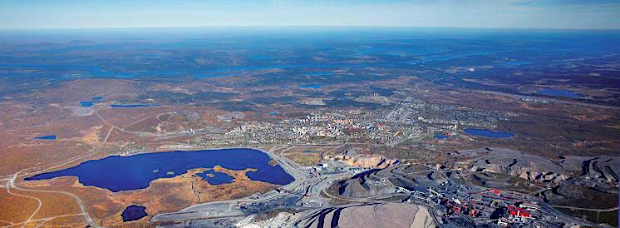
Kiruna Center from the southwest, with the LKAB facilities in the foreground

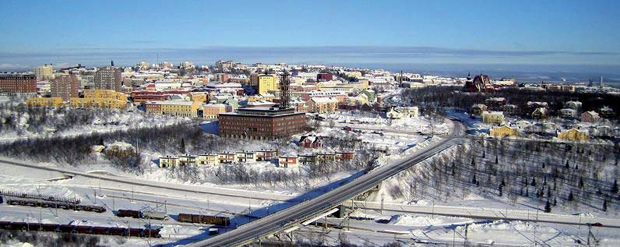
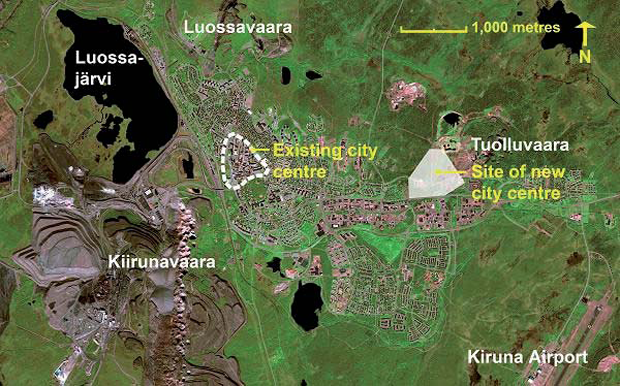
It’s an unusual, but very interesting challenge the Municipality of Kiruna is facing after more than a century of mining by the LKAB company. The ground is becoming unstable as some of the main tunnels are localised right underneath the city, so the city centre and all other areas affected will have to be relocated. In a time frame of approximately 20 to 25 years, some 400,000 sq. m. of housing and non-housing development will need to be replaced within the forecasting line of LKAB’s next main level, 1,365 metres below ground.

Map of Kiruna

The aim for the competition is to create a sustainable, distinctive and pleasant urban environment, a city centre linking together surrounding housing and industrial areas with the whole city and constituting the natural hub of the new Kiruna. This is an opportunity for creating something completely new, emanating from Kiruna’s unique history, to accommodate future needs and the desire for good living in an Arctic climate.

Kiruna, view of the city centre

We are very excited to start working with the other firms in our team in this competition, and we look forward to develop the future Kiruna during autumn 2012.