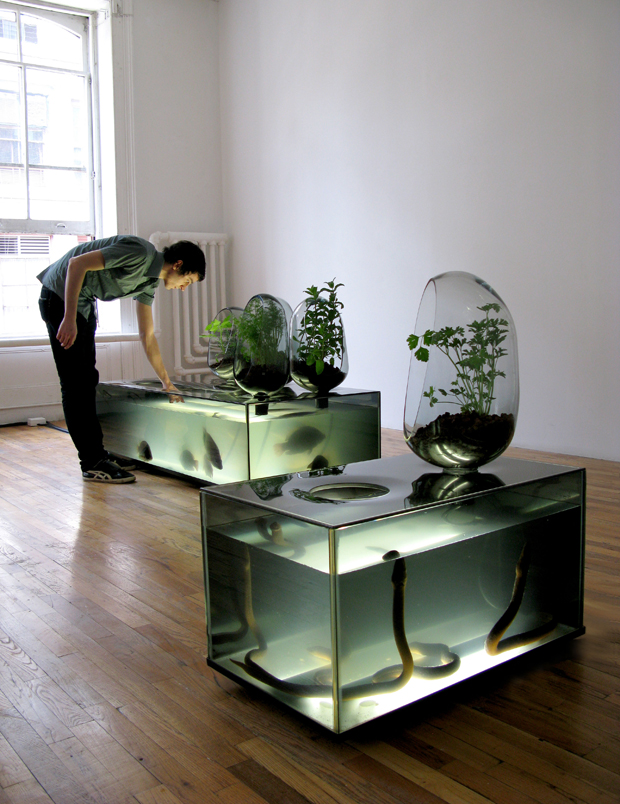
With Local River, french designer Mathieu Lehanneur has introduced a whole new dimension of conscious eating for fish-eating locavores. His freshwater aquarium-refrigerator design allows conscious foodies to raise their own fish and grow a vegetable patch in their living room. The system is supported by the natural exchange and interdependence between fish and plants: The plants extract the nutrient-rich water for growth while simultaneously acting as a natural filter, purifying the water to provide a healthy environment in which the fish can grow themselves. This process mimics natural pond ecology and maintains the vital balance for the ecosystem in which the fish live. It also allows fish eaters to better trace their culinary footprint, which, in an age of fish-decline due to extreme overfishing, is something worth acknowledging. continue reading
creativity
February 8, 2011
Innovate, create
Category: #follow+#followresearch+⚐ EN+creativity
Innovation, creativity power fresh thinking at Harvard
The heart pacemaker. Surgical anesthesia. Facebook. Even breathable chocolate.
Harvard’s combination of questing minds, passionate spirits, and intellectual seekers tackling society’s toughest problems fosters a creativity that has produced a stream of innovations, from novel inventions to history-making devices that provide profound benefits to the public.
Creative thinking is a key component of Harvard’s Schools, centers, and institutes. Many innovations have come from looking at old problems in new ways, from recognizing the importance of serendipitous results, and from understanding that failures are steps to success. That innovative spirit has long been part of Harvard’s DNA, leading to the first use of anesthesia at Massachusetts General Hospital in 1846 and the development of the pacemaker by Paul Zoll in the 1950s.
President Drew Faust highlighted this University role when she took office, noting that an institution of higher education has an “accountability to the future.”
“One of the most significant things about our research universities,” she told a gathering of civic and higher education leaders in Boston, “is that they are engines that also produce the fuel — the scientists, physicians, and engineers, the thinkers and ideas … that spur the new products, new jobs, and new companies that will help renew our economy.” continue reading
January 26, 2011
[im]possible living
Category: ⚐ EN+creativity
Today we present [im]possible living: an interesting project made by Daniela Galvani and Andrea Sesta.
“Abandoned buildings are everywhere: in city centers, suburbs, countrysides, mountains, seasides, everywhere! They are left there, day after day, night after night.
They don’t scream, they don’t bleed, they just loose a little piece everyday, so you don’t really realize that a certain place is falling down, until one day it’s impossible to recover it and the only thing that is possible to do is … breaking it down!!
How is our society managing those buildings? Most of the time it’s ignoring them, preferring to leave them behind and build new buildings instead! This approach it’s cheaper in the short term, but definitely it is not in the long run. continue reading
January 20, 2011
Bucky on stage
Category: ⚐ EN+creativity
Photo courtesy of the American Repertory Theater
Harvard gave R. Buckminster Fuller a gift beyond academics, his biographers say: a lifelong preoccupation with human welfare, and the social, technical, and economic problems that vex the modern age. “R. Buckminster Fuller: The History (and Mystery) of the Universe,” a two-act monologue performed by A.R.T. veteran Thomas Derrah, explores the life and ideas of the inventor and futurist.
R. Buckminster Fuller, the self-taught architect, inventor, and futurist who coined the term “Spaceship Earth,” entered Harvard College in the fall of 1913. But by 1915, he had been thrown out twice — he preferred the term “fired” — and never returned for a degree. continue reading
December 15, 2010
Public Design Festival edition n° 3 will be held in Milan from 12 to 17 april 2011 with a new formula: site specific projects scattered all over Milan from the city centre to the outskirts of town (Lambrate, Cadorna, Porta Romana, Garibaldi). Young designers, architects and projects makers can submit their projects to realise interventions, services, installations and public design projects.
Deadline January 31.
Public Design Festival is made of a constant research that brings to Milan selected projects from all over the world with the aim of giving space to public space in building future cities. Cities shall be citizen-friendly, they shall be built on people and relations, cities to live in, not to survive in. The winning projects for this edition will be presented in a urban course that will be visible for the whole city and ready to be experienced from the citizens and visitors of Public Design Festival. continue reading
May 28, 2010
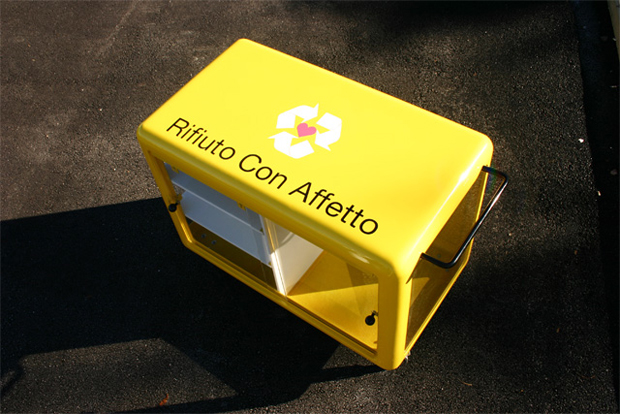
rifiuto con affetto
Category: ⚐ EN+creativity+sustainability
Objective
The aim of this project is to make people aware of the increasing amount of rubbish we throw away and choices for its disposal. How many times have we thought to ourselves “What a pity to throw this away!”. It just shows how often people throw away items which can still be used. RCA wants to change our attitude towards these objects and offer them a second life: if we throw away something “with love”, then someone else may “love it again”. What has become useless to someone, can become useful to someone else.
RCA enables the public to think twice before getting rid of unnecessary belongings and points out the importance of “wasting” in a critical and conscious way. continue reading
January 26, 2010
[ecosistema urbano] open calls for admission of candidates for a vacancy with fellow European mobility program Leonardo da Vinci.
Each year we support one or two trainees, and this year we have decided to make the call through the blog.
Date: From February to August 2010
Deadline for submissions: 03/02/10
Format: original presentation in pdf (no more than 5MB).
Send documents to michael@ecosistemaurbano.com
Leonardo Grants:
Since 1 January 2007 the Leonardo da Vinci is part of the Lifelong Learning Program, in conjunction with the Comenius, Erasmus and Grundtvig. Will be addressing the needs of teaching and learning of all participants in education and training, excluding tertiary level.
These are grants for placements in enterprises or in training institutions in other European Union country. They are addressed to students of Middle Level Training Cycles and people in the labour market (people who follow vocational training courses, recent graduates: college or vocational training background and degree courses, etc.).
The Leonardo da Vinci provides financial assistance to organizations that promote mobility projects.
To obtain a scholarship within the framework of the Leonardo da Vinci, you should contact one of these organizations witch have approved mobility projects (the Ministry of Education of your community, your University, your Institute, Chamber of Commerce, City Councils. ..).
Good Luck.
July 27, 2009
“Now, the first thing we need to recognize is that this is not just a time of challenge for America’s cities; it’s also a time of great change. Even as we’ve seen many of our central cities continuing to grow in recent years, we’ve seen their suburbs and exurbs grow roughly twice as fast — that spreads homes and jobs and businesses to a broader geographic area. And this transformation is creating new pressures and problems”.
“So what’s needed now is a new, imaginative, bold vision tailored to this reality that brings opportunity to every corner of our growing metropolitan areas” (Obama) continue reading
July 8, 2009
Yes, we camp!
Category: ⚐ EN+architecture+creativity
Yes, we camp! It’s the cry to denounce the crazy conduct of the after earthquake emergency.
For the first time in the recent history of earthquakes, after three months, people are still living under tents and they will have to stay there for a long time, according to the Government’s plans. continue reading